How to Remove Moisture From Attic: Causes, Fixes, and Prevention
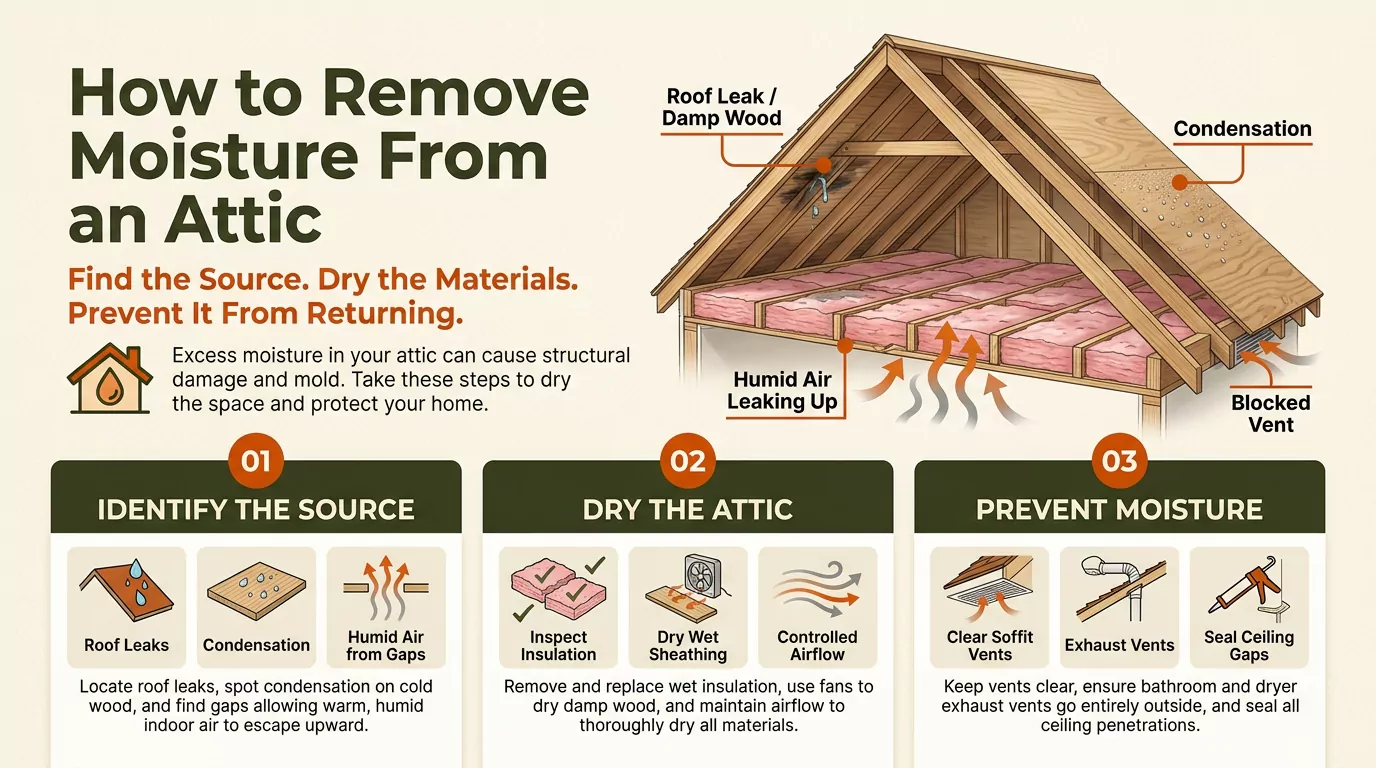
To remove moisture from an attic, first find and stop the moisture source. Then dry wet materials and improve airflow. You may also need air sealing, better ventilation, insulation repairs, or humidity control.
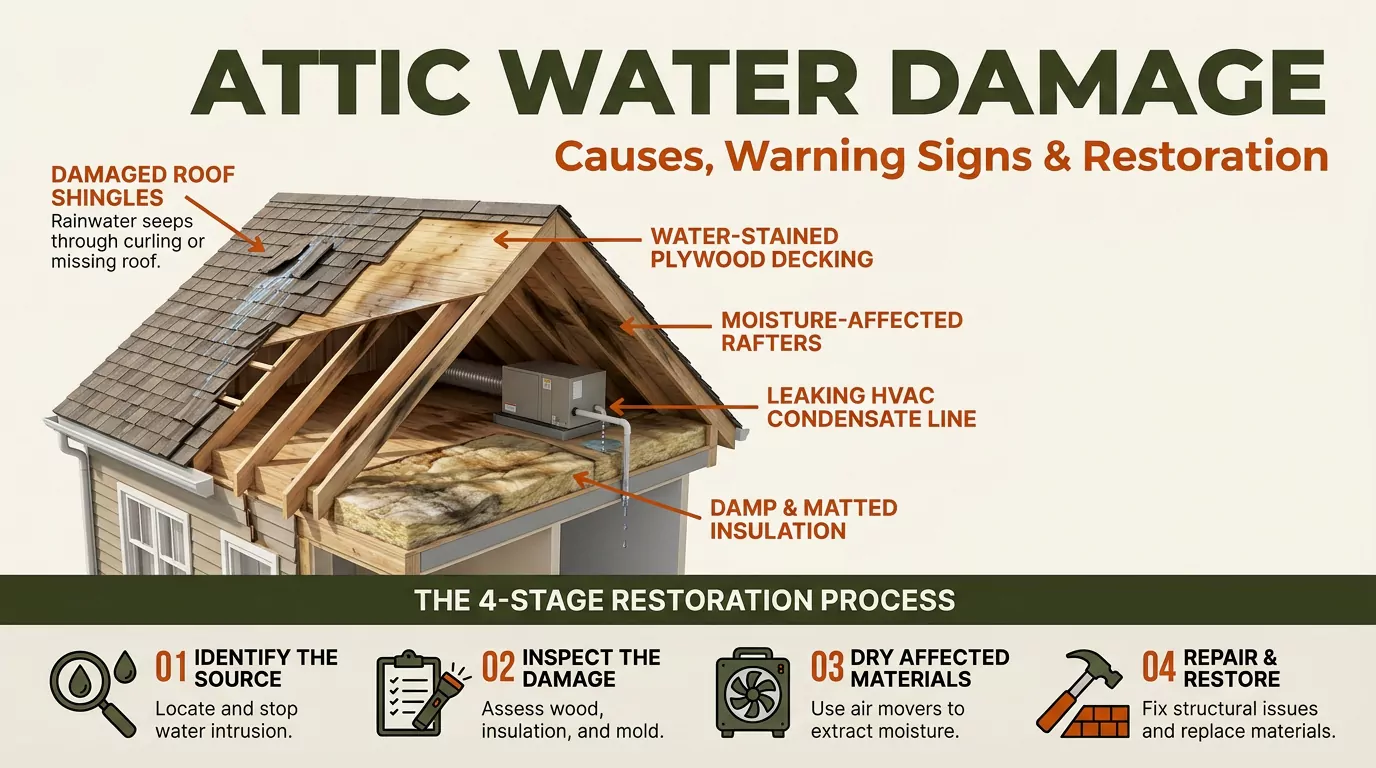
Attic moisture does not always come from a roof leak. It can also come from condensation, indoor humidity, air leakage, bathroom exhaust, kitchen exhaust, or a dryer vent. Each source requires a different solution.
Ignoring moisture can lead to mold, damaged insulation, wood deterioration, and roof problems. The right approach is to fix the cause instead of only treating the visible moisture.
What Causes Moisture in an Attic?
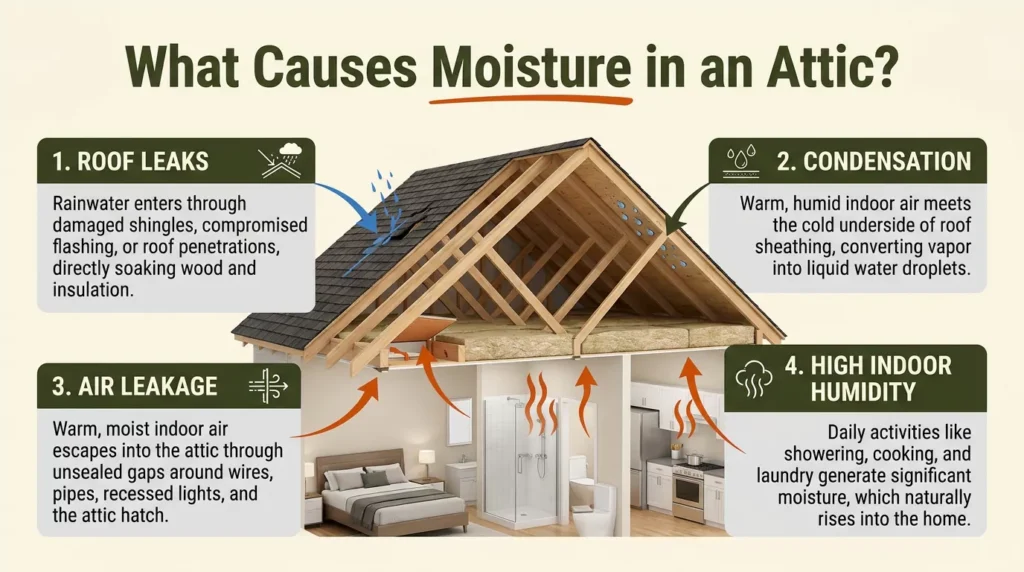
Attic moisture generally comes from four major sources:
- Liquid water from leaks
- Condensation from humid air
- Moisture carried through air leaks
- High indoor humidity
Understanding the source is the first step toward solving the problem.
Roof leaks
A roof leak introduces liquid water directly into the attic.
Rain can enter through damaged shingles, flashing, roof penetrations, or other roofing defects. Storm damage can also create new openings.
Roof leaks usually require a roofing repair before you focus on drying the attic. Drying wet insulation without fixing the leak will only provide a temporary solution.
Condensation
Condensation happens when warm, humid air contacts a cold surface. The roof sheathing can become very cold during winter.
Warm air from the living space can reach that surface through gaps in the ceiling plane. When the surface temperature falls below the air’s dew point, water vapor can condense.
You may see:
- Water droplets
- Frost
- Damp roof sheathing
- Rusted roofing nails
- Dark stains
- Mold growth
Condensation is especially important during cold weather.
Air leakage
Air leakage is another major moisture pathway.
Warm indoor air can escape through small openings around:
- Plumbing pipes
- Electrical wiring
- HVAC penetrations
- Attic hatches
- Recessed lights
- Ceiling fixtures
- Wall top plates
- Chimney openings
That escaping air can carry water vapor into the attic.
Air sealing reduces this uncontrolled movement of moisture-laden air. The semantic research specifically identifies ceiling penetrations and attic hatches as important areas to inspect.
Indoor humidity
High indoor humidity increases the amount of moisture available to enter the attic.
Common household moisture sources include:
- Showers
- Baths
- Cooking
- Laundry
- Drying clothes
- Humidifiers
- Poorly ventilated bathrooms
- Poorly ventilated kitchens
If indoor humidity remains high, attic condensation can become harder to control.
How to Tell if Your Attic Has Too Much Moisture
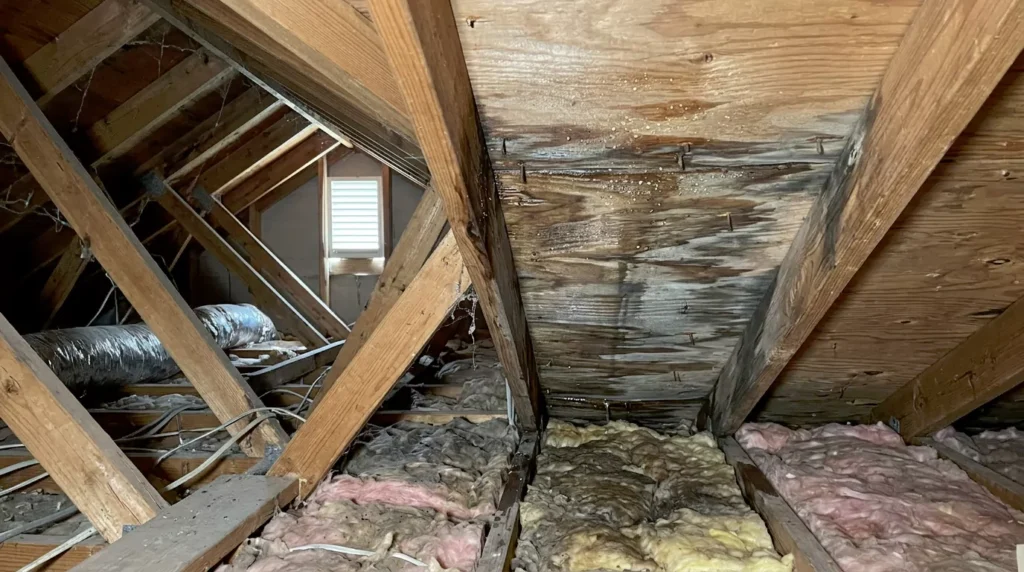
Some attic moisture problems are easy to see. Others require closer inspection.
Look for:
- Water stains
- Damp insulation
- Wet roof sheathing
- Frost
- Condensation
- Rust on roofing nails
- Dark discoloration
- Mold
- Musty odors
- Wood deterioration
- Peeling paint near attic areas
- Moisture around roof penetrations
A moisture meter can provide additional information when materials look dry but may still contain excess moisture.
Do not rely only on appearance when investigating a recurring moisture problem.
How to Remove Moisture From an Attic
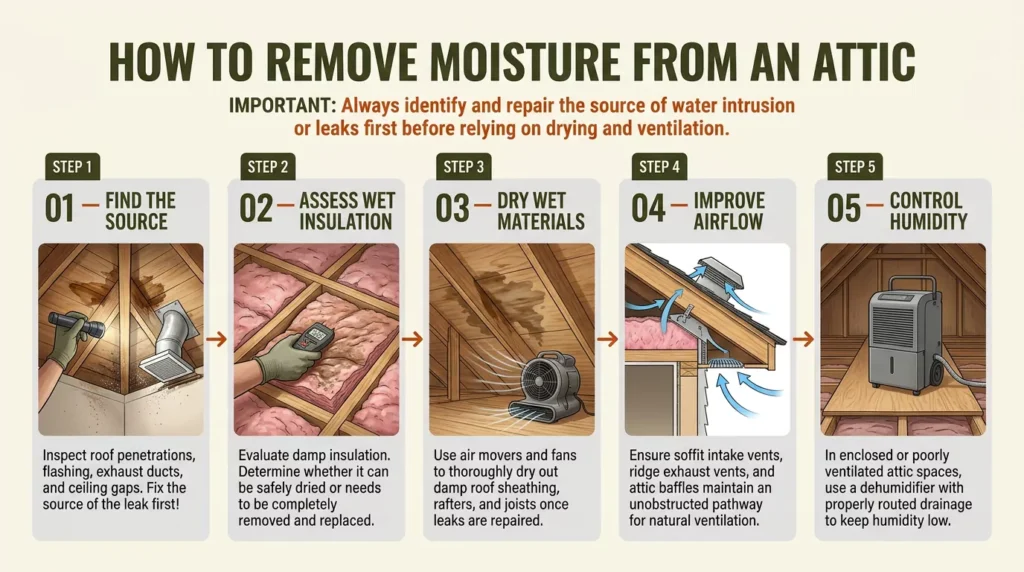
Removing moisture is not just about moving humid air outside.
Follow this general sequence.
1. Find and Stop the Moisture Source
Start by determining where the moisture is coming from.
Inspect the attic after rain if you suspect a roof leak. Look around roof penetrations, flashing, vents, and damaged roofing areas.
Also inspect:
- Bathroom exhaust ducts
- Kitchen exhaust ducts
- Dryer vents
- Plumbing vents
- HVAC equipment
- Ductwork
- Attic access points
If water is entering from outside, repair the source first. If humid air is entering from inside, air sealing and humidity control may be needed.
The distinction matters because roof leaks introduce liquid water, while air leakage transports water vapor.
2. Assess Wet Insulation
Wet insulation should be evaluated before deciding whether to keep it. The type of insulation matters.
Clean fiberglass that is only slightly damp may be salvageable after complete drying. Heavily saturated or mold-contaminated insulation may require replacement.
Cellulose that has become severely wet can also require removal. Do not cover wet insulation with new insulation. That can trap moisture and hide the underlying problem.
3. Dry Wet Wood and Roof Sheathing
Wet roof sheathing and framing need time to dry. Air movement can help accelerate drying. Fans can move air across affected surfaces.
Dehumidification may also help in appropriate situations. The important point is to control the moisture source first.
Fans cannot compensate for an active roof leak or a bathroom exhaust duct dumping humid air into the attic.
4. Improve Air Movement
A properly designed ventilation system can help move attic air.
Traditional vented attics often use:
- Soffit vents for intake
- Ridge vents for high-level exhaust
- Gable vents in some designs
- Attic baffles to maintain airflow pathways
The system works best when intake and exhaust airflow are properly balanced. Simply adding an exhaust fan does not automatically solve every moisture problem.
5. Use Dehumidification When Appropriate
A dehumidifier removes water vapor from the air. This can be useful in some enclosed or encapsulated attic spaces. It may also help during controlled drying after a moisture event.
However, dehumidification should not replace source correction. A dehumidifier cannot repair a roof leak. It also cannot correct a disconnected dryer vent or uncontrolled air leakage.
Think of it as a humidity-control tool rather than a universal moisture solution.
Fix the Cause So Moisture Does Not Return
Drying the attic is only half the job. The next step is preventing another moisture event.
Seal Air Leaks
Air sealing can reduce the amount of warm, humid indoor air entering the attic.
Common targets include:
- Attic hatches
- Plumbing penetrations
- Electrical openings
- HVAC penetrations
- Recessed lighting
- Ceiling fixtures
- Top plates
- Large framing openings
The goal is to create a stronger air barrier between the conditioned living space and the attic.
This is particularly important during cold weather, when warm indoor air can reach cold roof surfaces and condense.
Air sealing and insulation perform different jobs. Air sealing controls uncontrolled airflow, while insulation primarily controls heat transfer.
Vent Bathroom Exhaust Outdoors
Bathroom exhaust fans should discharge outdoors. They should not release warm, humid bathroom air directly into the attic.
A bathroom can produce a large amount of water vapor during showers. If that air enters the attic, the moisture can accumulate or condense on colder surfaces.
Check the entire exhaust route.
Look for:
- Disconnected ducts
- Crushed ducts
- Poor exterior termination
- Leaking connections
- Exhaust ducts ending inside the attic
This is one of the first areas worth checking when attic moisture appears near a bathroom.
Check the Kitchen Exhaust
Cooking produces moisture and airborne contaminants. Make sure the kitchen exhaust system is designed to discharge outdoors where applicable.
A recirculating range hood is different from an exterior exhaust system. It does not remove air from the home in the same way.
If moisture remains high during cooking, whole-home humidity control may also need attention.
Check the Dryer Vent
Dryer exhaust should discharge outdoors. A disconnected or damaged dryer duct can release warm, moisture-filled air into the attic.
Inspect for:
- Disconnected sections
- Crushed ductwork
- Leaks
- Improper termination
- Lint accumulation
A dryer vent problem can introduce substantial moisture into a small attic space.
Repair Roof and Plumbing Leaks
Not every attic moisture problem is caused by humidity.
Sometimes the simplest explanation is water entering from outside.
Inspect around:
- Roof penetrations
- Flashing
- Plumbing vents
- Chimneys
- Skylights
- Roof valleys
- Damaged shingles
- Storm-damaged areas
Water stains can help identify a problem, but the visible stain may not be directly below the entry point.
Water can travel along roof sheathing or framing before becoming visible.
Control Indoor Humidity
Reducing indoor humidity can lower the moisture load moving through the building.
Use exhaust fans during moisture-producing activities. Address persistent humidity problems instead of relying only on attic ventilation.
If indoor humidity remains unusually high, investigate the whole building.
Possible contributors include:
- Poor bathroom ventilation
- Cooking
- Laundry
- Crawlspace moisture
- Plumbing leaks
- Air infiltration
- HVAC problems
- Excessive humidification
A moisture problem can involve more than the attic itself.
Improve Attic Ventilation
Ventilation helps regulate temperature and moisture conditions in a properly designed vented attic.
A typical system uses low-level intake and high-level exhaust.
Soffit Vents
Soffit vents provide intake airflow near the roof edges. They need a clear pathway into the attic.
Insulation can accidentally block soffit openings. Debris can also restrict airflow.
Blocked intake ventilation can reduce the effectiveness of the entire ventilation system.
Ridge Vents
Ridge vents provide high-level exhaust. Warm attic air can move toward the highest part of the roof and exit through the ridge.
However, a ridge vent should not be viewed as a standalone moisture cure. It needs appropriate intake airflow to work as part of a complete ventilation system.
Attic Baffles
Baffles preserve the airflow path between soffit vents and the rafter bays. They help keep insulation from blocking the intake channel.
If you are adding or replacing insulation, check that the ventilation pathway remains open. The semantic research specifically connects attic baffles with maintaining soffit-to-rafter airflow.
Gable Vents
Some attic designs use gable vents instead of, or alongside, other ventilation strategies. Their effectiveness depends on the attic’s design and airflow pattern.
Do not assume that adding another vent will automatically improve moisture control. A ventilation system needs a deliberate intake and exhaust path.
Does Attic Insulation Help With Moisture?
Yes, but insulation is not a moisture-removal system. Insulation primarily reduces heat transfer.
It can help maintain more consistent temperatures and reduce heat movement between the living space and attic.
However, insulation does not fix:
- Roof leaks
- Plumbing leaks
- Bathroom exhaust problems
- Dryer vent problems
- Air leaks
- High indoor humidity
Poor insulation can also contribute to cold surfaces where condensation becomes more likely.
Gaps, compression, and insufficient insulation can reduce thermal performance. Therefore, moisture control should consider air sealing, insulation, and ventilation together.
Air Sealing vs. Insulation vs. Vapor Control
These terms are sometimes used interchangeably, but they describe different functions.
| Component | Main purpose |
| Air sealing | Controls uncontrolled air movement |
| Insulation | Reduces heat transfer |
| Vapor control | Limits moisture movement through material assemblies |
| Ventilation | Exchanges attic air in designed vented assemblies |
| Dehumidification | Removes water vapor from air |
Understanding these differences helps prevent the wrong repair.
For example, adding insulation will not stop a roof leak.
Likewise, adding ventilation will not necessarily solve an air leak around an attic hatch.
Winter vs. Summer Attic Moisture
Moisture behaves differently throughout the year.
Winter
Winter attic moisture is often associated with condensation. Warm indoor air contains water vapor. If that air enters a cold attic and reaches cold roof sheathing, condensation can occur. Frost may appear in especially cold conditions.
Winter moisture control therefore emphasizes:
- Air sealing
- Indoor humidity control
- Proper exhaust ventilation
- Insulation continuity
- Proper attic ventilation
Summer
Summer attics can become extremely hot. The main concern may shift toward heat transfer and humidity, depending on the climate and attic design.
In a traditional vented attic, ventilation can help remove accumulated heat. In an encapsulated attic, the moisture strategy can be different.
Air conditioning, HVAC ducts, insulation type, air sealing, and dehumidification may all affect the attic environment.
Seasonal temperature differences can change condensation risk, so the same attic may behave differently during winter and summer.
What About an Encapsulated or Unvented Attic?
An encapsulated attic is different from a traditional vented attic. In an unvented assembly, the building enclosure moves closer to the roofline.
That changes how heat and moisture move through the space.
Some encapsulated attics may use:
- HVAC supply air
- Controlled exhaust
- Dehumidification
- Vapor diffusion strategies
- Air-impermeable insulation
- Other deliberate moisture-control measures
The correct approach depends on the roof assembly, insulation, climate, HVAC design, and air-sealing strategy.
Do not treat a sealed attic like a traditional vented attic. An unvented attic requires deliberate temperature and humidity management.
Common Mistakes When Removing Attic Moisture
Only running an attic fan
A fan may move air, but it does not fix the moisture source.
Find the cause first.
Adding insulation over wet insulation
This can hide the problem and slow drying.
Assess the existing insulation before adding more.
Blocking soffit vents with insulation
This can restrict intake airflow.
Use appropriate baffles where needed.
Venting a bathroom into the attic
This sends moisture directly into the space you are trying to dry.
Exhaust air should be properly discharged outdoors.
Ignoring roof leaks
Condensation is not the only cause of wet insulation.
Always consider liquid water intrusion.
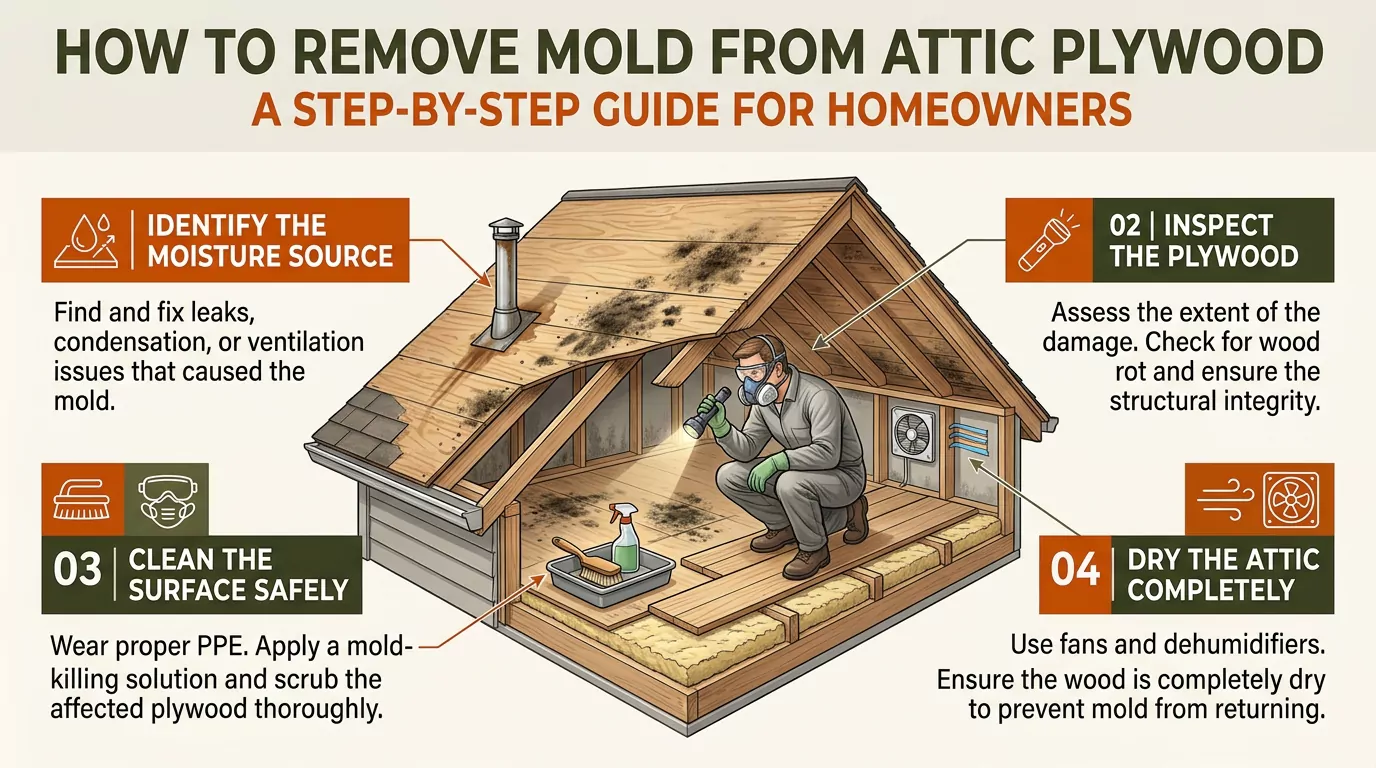
Treating mold without fixing moisture
Mold is a consequence of persistent moisture.
Removing visible mold without controlling the moisture source leaves the underlying problem.
Using a dehumidifier as the only solution
A dehumidifier can reduce humidity, but it cannot repair a leak or correct an improperly routed exhaust duct.
When Should You Call a Professional?
Professional assessment is appropriate when the moisture problem is persistent, widespread, or difficult to identify.
Consider professional help when you find:
- Extensive mold
- Significant wood deterioration
- Repeated condensation
- Saturated insulation
- A suspected roof leak
- Difficult-to-access moisture
- Persistent humidity
- HVAC or ductwork problems
- An encapsulated attic with humidity issues
- Structural concerns
Persistent moisture can affect roof sheathing and framing over time. A professional can help determine whether the problem involves roofing, insulation, HVAC, ventilation, or the building envelope.
The supplied semantic research also identifies professional assessment as appropriate for complex moisture problems involving multiple interacting causes.
Attic Moisture Prevention Checklist
Use this checklist during routine attic inspections:
- Check the roof for signs of leaks.
- Inspect roof sheathing for stains or dampness.
- Look for frost or condensation.
- Check insulation for moisture.
- Inspect bathroom exhaust ducts.
- Check kitchen exhaust routing.
- Inspect the dryer vent.
- Check plumbing penetrations.
- Inspect the attic hatch.
- Look for ceiling-plane air leaks.
- Make sure soffit vents are open.
- Check attic baffles.
- Inspect ridge or gable ventilation.
- Look for mold.
- Check for wood deterioration.
- Investigate persistent indoor humidity.
- Monitor recurring moisture after storms.
- Consider a moisture meter for suspicious materials.
Regular maintenance can reduce the chance of recurring moisture problems.
Frequently Asked Questions
How do I get moisture out of my attic?
First, identify and stop the moisture source. Then dry wet materials using appropriate airflow and dehumidification. Finally, correct ventilation, air leakage, exhaust routing, or other underlying problems.
How do I dry a wet attic quickly?
Stop the moisture source first. Remove severely damaged materials when appropriate. Then use controlled airflow and dehumidification to help dry affected areas.
The drying method depends on how much water entered the attic and which materials became wet.
Can an attic fan remove moisture?
An attic fan can help exchange air in some properly designed attic systems. However, it cannot fix a roof leak, disconnected exhaust duct, or major air leak.
Ventilation should be part of a complete moisture-control strategy.
Should I use a dehumidifier in my attic?
A dehumidifier can be useful in certain enclosed or encapsulated attic spaces. It can also support controlled drying.
However, it should not replace repairing leaks or correcting moisture sources.
Why is my attic wet in winter?
Winter attic moisture often results from warm, humid indoor air reaching cold attic surfaces.
Air leakage through ceiling penetrations can carry water vapor into the attic. That vapor can condense when it reaches cold roof sheathing.
Can wet insulation be dried?
Some clean, slightly damp insulation may be salvageable after complete drying.
Heavily saturated, damaged, or mold-contaminated insulation may require removal.
The appropriate decision depends on the insulation type and extent of moisture exposure.
Should bathroom fans vent into the attic?
No. Bathroom exhaust should be properly discharged outdoors.
Sending humid bathroom air into the attic can create persistent moisture problems.
How do I stop attic condensation?
Start by reducing the amount of warm, humid air entering the attic.
Air seal ceiling penetrations, control indoor humidity, ensure exhaust fans discharge properly, and maintain appropriate attic ventilation.
Does insulation prevent attic moisture?
Insulation helps reduce heat transfer but does not independently remove moisture.
Effective moisture control may also require air sealing, ventilation, exhaust correction, leak repair, or humidity control.
How do I know if attic moisture caused damage?
Look for mold, dark staining, rusted nails, deteriorated roof sheathing, soft wood, damaged insulation, and persistent dampness.
A moisture meter can provide additional information when visual inspection is inconclusive.
Can attic moisture cause mold?
Yes. Persistent moisture creates conditions that can support mold growth.
The most important step is controlling the moisture source rather than treating mold alone.
Final Takeaway
The best way to remove moisture from an attic is to solve the source before treating the symptom.
Start by determining whether the moisture comes from a roof leak, condensation, indoor humidity, air leakage, or improperly vented exhaust.
Then dry the affected materials and correct the underlying problem.
For a traditional vented attic, that may involve air sealing, insulation improvements, clear soffit intake paths, proper exhaust ventilation, and corrected bathroom or dryer vents.
For an encapsulated attic, the strategy can be different. Humidity control, HVAC operation, insulation, air sealing, and dehumidification may all need consideration.
The goal is not simply to make the attic dry today. The goal is to create conditions that keep moisture from returning.

Daniel Carter specializes in attic maintenance, insulation, ventilation, moisture control, and home improvement. He understands common attic problems and their practical solutions. Through clear, informative guides, he helps homeowners identify issues, prevent damage, improve energy efficiency, and maintain safer, healthier homes.