Radiant Barrier Insulation for Attic: Benefits, Cost & Installation
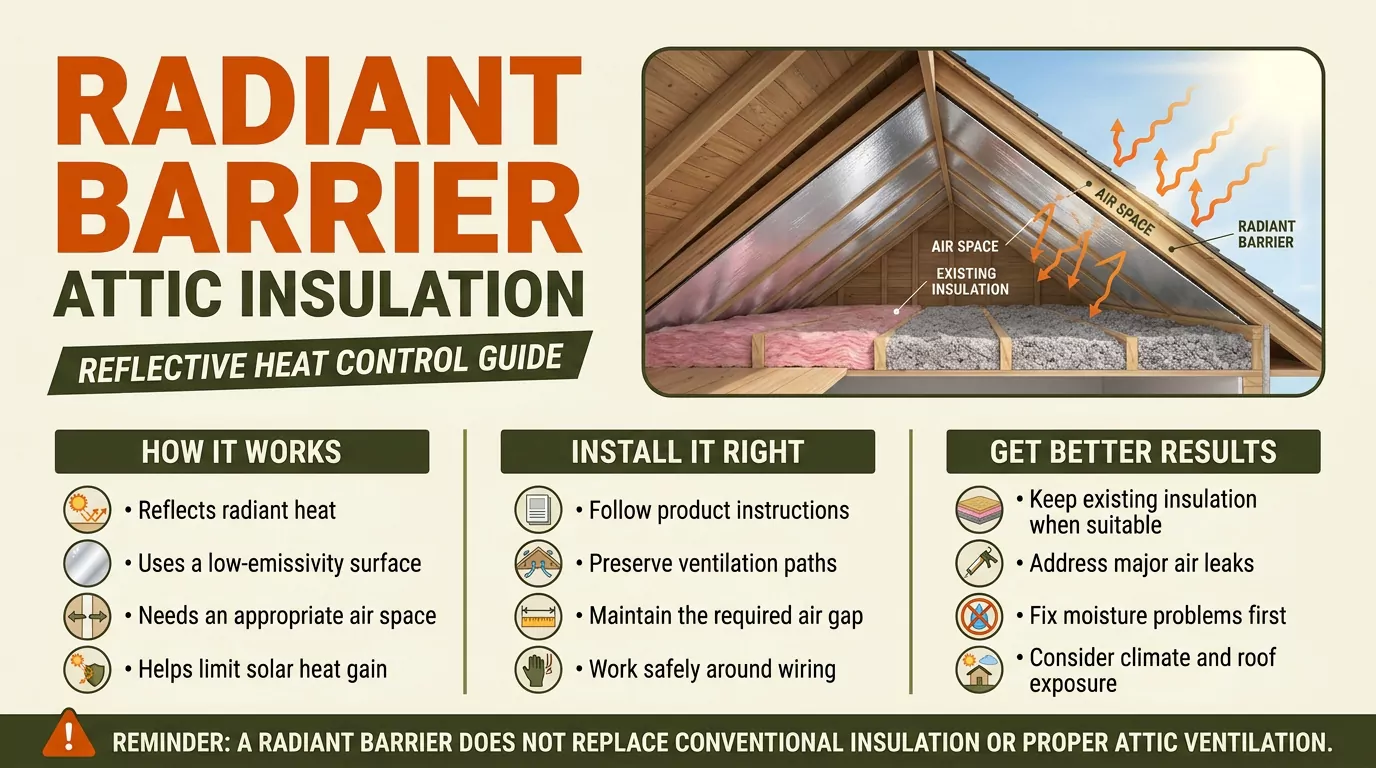
Radiant barrier insulation helps reduce radiant heat entering an attic. It uses a reflective, low-emissivity surface to reflect radiant energy.
It works differently from fiberglass, cellulose, and spray foam insulation.
A radiant barrier does not simply add conventional thermal resistance. Instead, it targets radiant heat from a hot roof.
This makes it especially relevant in hot, sunny climates with significant cooling demand.
The best results also depend on proper placement, air space, and ventilation.
This guide explains how radiant barriers work and where they fit. It also covers installation, costs, safety, and common mistakes.
What Is Radiant Barrier Insulation for an Attic?
A radiant barrier is a reflective material designed to reduce radiant heat transfer.
Many attic radiant barriers use reflective foil surfaces. Aluminum is commonly used because it has high reflectivity and low emissivity.
During a hot, sunny day, solar radiation heats the roof.
The roof then becomes a major source of radiant heat inside the attic.
A properly positioned radiant barrier reflects much of this radiant energy. This can reduce the amount of radiant heat reaching attic surfaces.
However, a radiant barrier is not the same as bulk insulation.
Bulk insulation mainly slows heat moving through conduction and convection. A radiant barrier primarily controls radiant heat transfer.
That difference is important when planning an attic upgrade.
How Does an Attic Radiant Barrier Work?
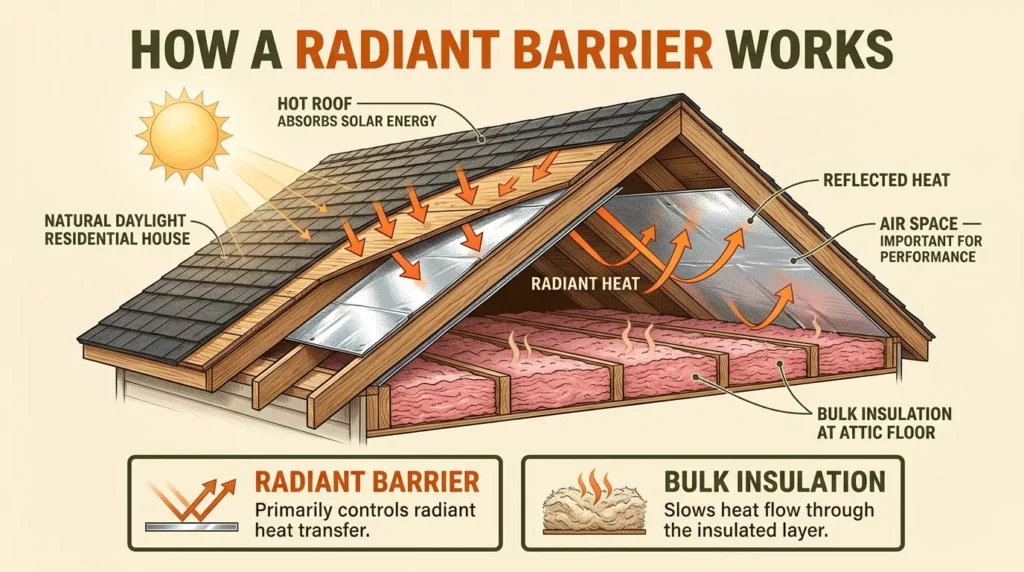
The sun sends energy toward your roof through solar radiation. Your roofing materials absorb part of that energy. The roof becomes hot as a result.
Some of that heat moves through the roof assembly. Some also radiates toward surfaces inside the attic.
A radiant barrier changes this part of the heat-transfer process. Its reflective surface sends much of the radiant energy back toward the hotter surface.
Radiant heat is different from conductive heat
- Heat can move through a building in several ways.
- Radiation travels through electromagnetic energy.
- Conduction moves heat through physical materials.
- Convection transfers heat through moving air.
- Radiant barriers mainly address radiation.
- Fiberglass, cellulose, and spray foam address other heat-transfer paths.
- This is why the two approaches should not be treated as identical.
Why Reflectivity and Emissivity Matter
Two properties are especially important when discussing radiant barriers. They are reflectivity and emissivity.
Reflectivity describes how much radiant energy a surface reflects. Emissivity describes how effectively a surface emits radiant energy.
A useful radiant barrier has a highly reflective surface with low emissivity. The surface works best when it faces an appropriate air space.
That air space allows the reflective surface to interact with radiant energy.
Does a Radiant Barrier Need an Air Gap?
Yes, an appropriate air space is important for radiant-barrier performance. A reflective surface should not simply be pressed against another solid material.
The surrounding assembly determines how the radiant surface performs.
This is especially important when installing material against rafters or other roof components.
Always follow the product manufacturer’s installation requirements.
Different products can have different construction and installation requirements.
Why the air space matters
The reflective surface needs an exposed boundary for radiant heat exchange.
Without the appropriate space, the system may not perform like a true radiant barrier.
This is one reason installation location matters as much as the material itself.
Does a Radiant Barrier Replace Attic Insulation?
No.
A radiant barrier and conventional attic insulation perform different functions. A radiant barrier mainly reduces radiant heat transfer.
Bulk insulation mainly slows heat transfer through the insulated layer.
For many attics, the two systems can work together. For example, an attic may already contain fiberglass or cellulose insulation.
A radiant barrier can address radiant heat from the roof while existing insulation handles other heat-transfer paths.
Radiant barrier vs. common attic insulation
| Material | Main function | Typical role |
| Radiant barrier | Reflects radiant heat | Controls solar-driven radiant heat |
| Fiberglass | Provides thermal resistance | Slows heat flow through the insulation layer |
| Cellulose | Provides thermal resistance | Insulates attic floors and other assemblies |
| Spray foam | Insulates and can air seal | Used in selected attic assemblies |
The right system depends on the attic design. Do not remove good existing insulation simply to install reflective material.
First evaluate how the existing assembly works.
Where Can You Install a Radiant Barrier?
There are several possible installation locations.
The correct option depends on the roof assembly, ventilation, product design, and existing insulation.
Under the Attic Rafters
Rafter installation places the reflective material along the underside of the roof assembly.
This approach can create a reflective surface between the hot roof and the attic interior.
It is often considered when the roofline provides suitable access.
The installation must preserve required ventilation pathways.
It must also maintain the appropriate air space.
Beneath the Roof Deck
Some radiant-barrier products can be installed beneath the roof deck.
The exact installation depends on the product and roof assembly.
This placement can put the reflective surface close to the source of solar heat.
However, the installation should not be planned without considering roof ventilation and moisture.
Over Existing Attic-Floor Insulation
Some products are designed for installation over existing attic insulation.
This configuration differs from rafter installation.
The product must be suitable for that application.
The reflective surface must also have the conditions required by its design.
Do not assume every foil product can simply be placed over insulation.
How to Install Radiant Barrier on Attic Rafters
Rafter installation can be a practical DIY project in suitable attics.
However, the roof geometry and safety conditions matter.
Always follow the product instructions before fastening material.
Step 1: Inspect the Attic
Start by checking the attic before buying materials.
Look for:
- Roof leaks
- Moisture damage
- Mold
- Exposed wiring
- Damaged insulation
- Ventilation openings
- Roof penetrations
- Ductwork
- Heat-producing equipment
Fix major building problems first.
A radiant barrier will not repair a leaking roof.
It will not solve persistent condensation either.
Step 2: Plan Coverage and Ventilation
Map the roof area before cutting material.
Identify soffit vents and other intake openings.
Also identify ridge vents and other exhaust pathways.
Do not cover ventilation openings with the radiant barrier.
A continuous ventilation pathway may be important for attic moisture control.
Your installation plan should protect that pathway.
Step 3: Measure and Cut the Material
Measure the rafter areas carefully.
Account for roof geometry and obstacles.
You may need openings around:
- Bracing
- Electrical components
- Ventilation paths
- Ductwork
- Structural members
- Other roof penetrations
Cutting material outside the attic can make installation easier.
It also reduces the amount of cutting required while working overhead.
Step 4: Fasten the Radiant Barrier
Position the material according to the manufacturer’s instructions.
Keep the reflective surface facing the required direction.
Use the specified fastening method.
Avoid unnecessary tears or damage.
Be especially careful around electrical wiring.
Do not blindly staple through areas containing wires.
If electrical components create uncertainty, use qualified help.
Step 5: Finish Around Obstacles and Vents
Work carefully around structural obstacles.
Do not cover required soffit or ridge ventilation.
Avoid blocking designed airflow channels.
Check the finished surface for:
- Large gaps
- Tears
- Loose sections
- Blocked vents
- Incorrect orientation
- Missing air space
A final inspection can catch problems before they affect performance.
Radiant Barrier and Attic Ventilation
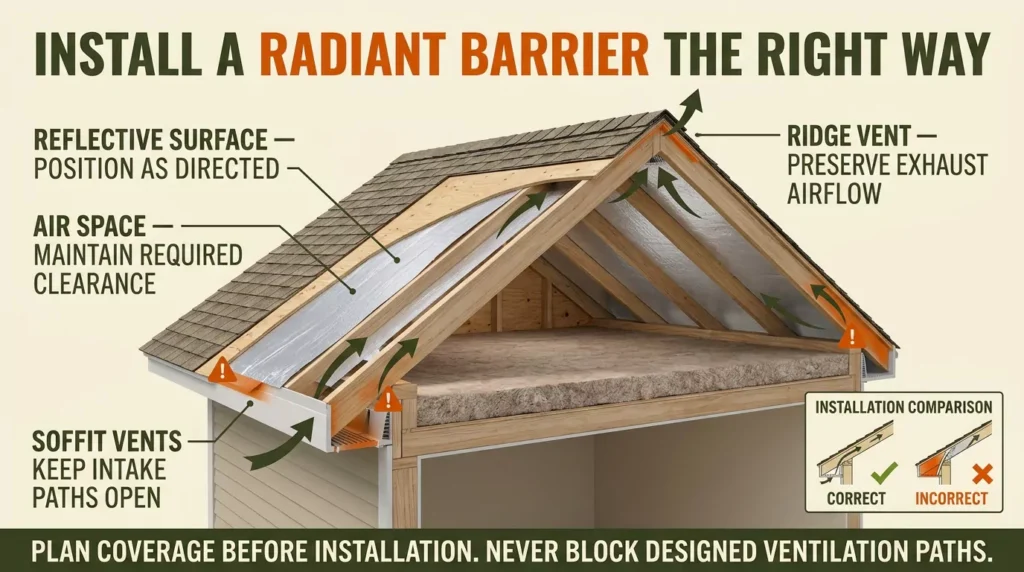
Radiant barriers and attic ventilation perform different jobs.
The radiant barrier controls radiant heat transfer.
Ventilation helps manage attic air movement and moisture conditions.
The two should work together.
Soffit vents
Soffit vents commonly provide low-level intake airflow.
Air can enter through these openings and move upward.
The radiant barrier should not block the designed intake pathway.
Ridge vents
Ridge vents provide high-level exhaust in suitable ventilation systems.
Warm attic air can move toward these high points.
The installation should preserve the designed airflow path.
Do not seal the attic accidentally
A common mistake is covering every roof surface without considering ventilation.
That can interfere with an existing ventilation strategy.
Always identify the intake and exhaust paths first.
Does a Radiant Barrier Help Lower Attic Temperatures?
A radiant barrier can reduce radiant heat entering an attic.
That can affect the heat balance inside the attic.
However, it does not eliminate solar heat gain.
The final result depends on several factors.
These include:
- Climate
- Roof orientation
- Solar exposure
- Attic ventilation
- Existing insulation
- Roof construction
- Duct location
- Installation quality
Therefore, avoid treating one temperature reduction as universal.
Different homes can produce very different results.
Is Radiant Barrier Insulation Worth It?
A radiant barrier can be worth considering when solar heat gain is a major attic problem.
It generally has a stronger use case in hot, sunny climates.
The benefit may also be more relevant when air-conditioning demand is high.
A radiant barrier may be worth considering when:
- Your attic receives strong solar exposure.
- Your climate has hot summers.
- Cooling represents a significant household load.
- HVAC ducts run through the attic.
- Your existing insulation is already adequate.
- You want to reduce radiant heat transfer.
- Your roof assembly supports proper installation.
It may be a lower priority when:
- Your attic has major air leaks.
- Your insulation is severely inadequate.
- Your roof has moisture problems.
- Your attic ventilation is poor.
- Your climate has limited summer cooling demand.
- The installation cannot maintain the required air space.
In these situations, other improvements may deserve attention first.
Radiant Barrier vs. Fiberglass Insulation
Fiberglass is a conventional bulk insulation material.
It slows heat transfer through the insulation layer.
A radiant barrier works through a different mechanism.
Fiberglass can therefore remain useful even when a radiant barrier is added.
For many homes, the question is not which material wins.
The better question is whether the building assembly needs both functions.
Radiant Barrier vs. Cellulose Insulation
Cellulose is another common attic insulation material.
It is often installed as loose-fill insulation.
Its primary role is providing thermal resistance.
A radiant barrier instead targets radiant heat.
These materials can therefore serve complementary roles.
Do not remove cellulose simply because you want a radiant barrier.
Evaluate the complete attic assembly first.
Radiant Barrier vs. Spray Foam
Spray foam serves a different building-envelope purpose.
It can provide thermal insulation.
Certain spray foam systems can also provide air sealing.
A radiant barrier does not perform the same function.
This makes the comparison more complex than choosing one product.
If air leakage is a major problem, air sealing deserves attention.
If solar-driven radiant heat is the main concern, radiant control may help.
The attic design determines which approach makes sense.
What About R-Value?
R-value measures resistance to heat flow through a material or assembly.
Radiant barriers should not automatically be assigned an R-value equivalent to bulk insulation.
Their primary mechanism is radiant reflection.
This is why comparing a radiant barrier directly with a high-R-value insulation product can be misleading.
The two products address different heat-transfer mechanisms.
When evaluating an attic, consider the entire assembly rather than one number.
Radiant Barrier and Existing Attic Insulation
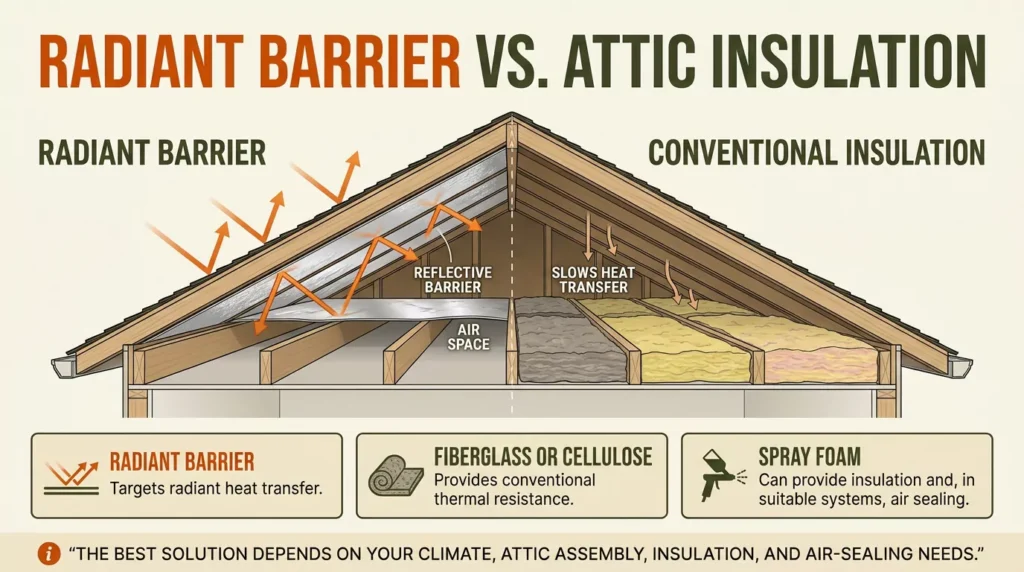
Existing insulation does not automatically need removal.
In many situations, keeping effective bulk insulation makes sense.
The radiant barrier can address radiant heat while the existing insulation handles other heat-transfer paths.
However, installation conditions matter.
The barrier should not create moisture problems.
It should not block required ventilation.
It should also meet the manufacturer’s requirements for the chosen location.
Air Sealing Should Not Be Ignored
Radiant barriers are not a substitute for attic air sealing.
Air can move through gaps around:
- Plumbing penetrations
- Electrical penetrations
- Duct openings
- Ceiling fixtures
- Attic hatches
- Other building-envelope openings
Uncontrolled air movement can carry heat and moisture.
Therefore, air sealing can be an important part of an attic upgrade.
A radiant barrier should be considered as one part of the larger building-envelope strategy.
Moisture Control Matters
A radiant barrier does not waterproof an attic.
It does not fix roof leaks.
It does not automatically prevent condensation.
It does not remove existing mold.
Persistent attic moisture needs a separate solution.
Check the roof, ventilation, air leakage, and moisture sources before installation.
If significant moisture damage already exists, resolve that problem first.
Perforated vs. Solid Radiant Barrier
Radiant barrier products can have different constructions.
Some products are perforated.
Others are designed as solid reflective sheets.
The correct choice depends on the product and assembly.
A perforated product may be appropriate for certain applications where vapor movement is a consideration.
However, you should not assume that every attic requires perforated material.
Follow the manufacturer’s instructions and local building requirements.
The important point is to avoid creating an unintended moisture problem.
Common Radiant Barrier Installation Mistakes
Several mistakes can reduce the value of an installation.
Blocking ventilation
Do not cover designed soffit or ridge ventilation paths.
Removing good insulation unnecessarily
A radiant barrier does not automatically replace existing bulk insulation.
Ignoring air space
The reflective surface needs the appropriate adjacent air space.
Stapling near electrical wiring
Fastening blindly can damage electrical components.
Installing over moisture problems
A radiant barrier cannot solve leaks or condensation.
Covering everything without planning
Attic geometry requires careful measurement and layout.
Treating all foil products as identical
Product construction and installation requirements can differ.
Expecting universal energy savings
Results depend on climate, roof design, insulation, ducts, and installation quality.
Can You Install a Radiant Barrier Yourself?
Some installations can be suitable for capable DIY homeowners.
The difficulty depends heavily on attic access and roof geometry.
A simple, accessible attic is different from a steep or difficult roof assembly.
DIY installation requires safe working conditions.
Use appropriate lighting and protective equipment.
Maintain secure footing.
Avoid stepping between structural supports.
Also watch for electrical wiring and hot equipment.
Consider professional help when:
- The roof is difficult to access.
- The attic has major moisture problems.
- Electrical wiring is difficult to identify.
- The roof assembly is unusual.
- Ventilation requirements are unclear.
- The installation requires significant structural work.
- You cannot safely work near the rafters.
Safety should come before project speed.
Radiant Barrier Cost Factors
The cost of a radiant barrier project depends on the entire installation.
Important factors include:
- Attic size
- Material type
- Product quality
- Installation location
- Fasteners
- Access difficulty
- Roof geometry
- Labor
- Existing insulation
- Required preparation
DIY installation can reduce labor costs.
Professional installation can increase upfront costs.
However, the cheapest installation is not always the best value.
A poorly installed barrier may provide less benefit than expected.
How to Decide If Your Attic Needs a Radiant Barrier
Use this simple decision process.
1. Check your climate
Hot, sunny climates generally provide a stronger use case.
2. Check the roof exposure
A roof exposed to strong solar radiation can create substantial attic heat.
3. Check existing insulation
Determine whether your current bulk insulation is adequate.
4. Check duct location
Hot attic ductwork can increase cooling demand.
5. Check ventilation
Make sure the attic has an appropriate ventilation strategy.
6. Check air leakage
Address major attic-floor air leaks when appropriate.
7. Check moisture
Resolve leaks and persistent moisture before installation.
8. Check installation feasibility
Make sure the reflective material can be installed correctly.
This approach helps prioritize improvements based on the actual attic.
Benefits of Radiant Barrier Insulation
A properly designed radiant barrier system can offer several benefits.
- Reduces radiant heat transfer.
- Helps limit solar-driven attic heat gain.
- Can complement conventional insulation.
- May reduce heat reaching attic ductwork.
- Can be useful in hot climates.
- May improve summer comfort when conditions are suitable.
- Can be installed in several attic configurations.
- May be suitable for some DIY projects.
The actual benefit depends on the home and installation.
Limitations of Radiant Barrier Insulation
Radiant barriers also have clear limitations.
They do not replace every type of insulation.
They do not solve air leaks.
They do not repair roof leaks.
They do not eliminate the need for attic ventilation.
They do not provide the same function as spray foam.
They also may provide less value in climates with limited cooling demand.
Understanding these limits helps prevent unrealistic expectations.
Frequently Asked Questions
Does radiant barrier insulation really work?
Yes, radiant barriers can reduce radiant heat transfer when properly installed.
Their effectiveness depends on the reflective surface, air space, climate, and attic assembly.
Does radiant barrier insulation have an R-value?
A radiant barrier should not be treated as equivalent to conventional bulk insulation.
R-value primarily describes resistance to heat flow through an insulating material or assembly.
Radiant barriers mainly work through radiant reflection.
Does a radiant barrier need an air gap?
An appropriate air space is important for radiant-barrier performance.
The exact requirements depend on the product and installation assembly.
Always follow the manufacturer’s instructions.
Can I install a radiant barrier over existing attic insulation?
Some products are designed for this application.
However, not every radiant barrier can be installed this way.
Check the product requirements before installation.
Should radiant barrier material be perforated?
That depends on the product and attic assembly.
Perforated products may be appropriate for certain applications.
Do not select a product based only on the word “perforated.”
Can radiant barrier block attic ventilation?
It can if installed incorrectly.
The material should not block designed ventilation pathways.
Pay special attention to soffit and ridge vent areas.
Is a radiant barrier useful in a hot climate?
Hot, sunny climates generally provide a stronger use case.
Solar radiation can create substantial roof heat gain.
Reducing radiant heat transfer can therefore be useful.
Can a radiant barrier replace fiberglass insulation?
No.
Fiberglass and radiant barriers work through different heat-transfer mechanisms.
A radiant barrier does not automatically replace adequate bulk insulation.
Can a radiant barrier replace cellulose insulation?
No.
Cellulose provides bulk thermal resistance.
A radiant barrier primarily reflects radiant energy.
They can serve complementary purposes.
Is radiant barrier better than spray foam?
Neither is universally better.
They address different building-envelope problems.
Spray foam can provide insulation and air sealing.
A radiant barrier primarily controls radiant heat.
Does a radiant barrier stop attic moisture?
No.
It does not fix roof leaks or automatically solve condensation.
Moisture control requires separate attention.
Is radiant barrier insulation worth installing?
It can be worthwhile when solar heat gain is a significant attic load.
The strongest candidates usually have hot summers and substantial cooling demand.
Existing insulation, ventilation, duct location, and installation cost also matter.
Can I install radiant barrier insulation myself?
Some attic installations are suitable for DIY homeowners.
However, attic safety and electrical hazards must be taken seriously.
Professional help is appropriate when access or installation conditions are difficult.
Final Takeaway
Radiant barrier insulation works differently from conventional attic insulation.
It primarily reduces radiant heat transfer from a heated roof.
That makes it especially relevant for hot, sunny conditions.
The reflective surface needs the right installation conditions, including appropriate air space.
Ventilation pathways must remain functional.
Existing fiberglass or cellulose insulation may still have an important role.
Before installing a radiant barrier, inspect the attic for moisture, air leaks, electrical hazards, and ventilation problems.
Then consider the climate, roof exposure, ductwork, existing insulation, and project cost.
The best attic solution is rarely one material alone.
It is a properly designed system that manages radiant heat, conductive heat, air movement, and moisture together.

Daniel Carter specializes in attic maintenance, insulation, ventilation, moisture control, and home improvement. He understands common attic problems and their practical solutions. Through clear, informative guides, he helps homeowners identify issues, prevent damage, improve energy efficiency, and maintain safer, healthier homes.