Mineral Wool Attic Insulation: What It Is and How It Works
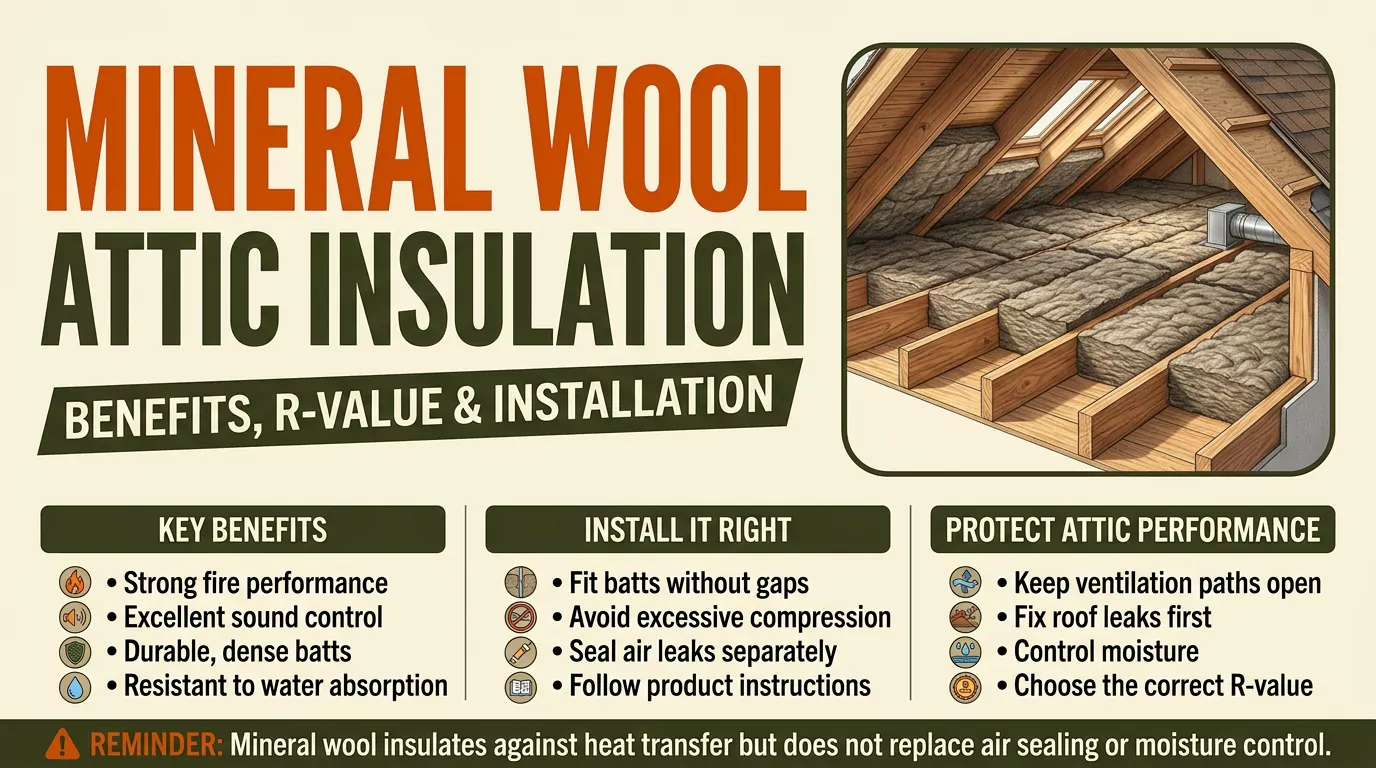
Mineral wool attic insulation is a dense, fiber-based insulation material. It slows heat transfer through attic floors, walls, and roof assemblies.
It is commonly available as batts and rigid insulation products. Mineral wool is also called rock wool or stone wool in many applications.
Its main strengths include strong fire performance, good sound control, durability, and resistance to water absorption. However, mineral wool does not replace air sealing.
The best installation method depends on your attic design. A vented attic often places insulation at the attic floor. A conditioned attic may use insulation along the roofline instead.
What Is Mineral Wool Insulation?
Mineral wool is insulation made from mineral-based materials. Common forms include rock wool and slag wool.
Rock wool is produced primarily from natural rock or mineral materials. Slag wool uses industrial mineral byproducts, such as blast-furnace slag.
Manufacturers heat these materials until they melt. They then form the material into fine fibers. The fibers create a dense insulation structure.
The finished material can be formed into batts, boards, and other products.
Mineral wool is different from fiberglass. Fiberglass uses glass fibers instead of mineral fibers.
Mineral wool vs. rock wool
The terms can cause confusion.
Mineral wool describes the broader insulation category. Rock wool describes a common type within that category.
Slag wool is another recognized mineral wool type.
For homeowners, product specifications matter more than terminology alone. Always check the product label and installation instructions.
Is Mineral Wool Good for Attic Insulation?
Yes, mineral wool can be effective attic insulation when the product suits the assembly.
It can work especially well between roof rafters and in sloped ceiling assemblies. Mineral wool batts can also be used at suitable attic floors.
However, the best material depends on the attic layout.
Flat attic floors often contain many obstacles and irregular areas. Loose-fill insulation can cover these areas more easily.
Mineral wool batts work differently. They are preformed sections that fit between framing members.
That makes them useful where accurate cavity fitting is practical.
Mineral wool attic insulation is useful when you want:
- Strong fire performance
- Dense insulation
- Good sound control
- Rigid batts
- Durable insulation
- Resistance to water absorption
- Precise fitting between framing
The installation must still match the attic assembly.
How Does Mineral Wool Insulation Work?
Mineral wool reduces heat transfer through its fibrous structure.
Heat can move through a building by conduction, convection, and radiation. Insulation mainly works by slowing conductive and convective heat movement.
The fibers create many small spaces. These spaces reduce heat movement through the insulation.
The result is measured using R-value.
A higher R-value indicates greater resistance to heat flow under the conditions used for the rating.
What is R-value?
R-value measures thermal resistance.
Mineral wool does not have one universal R-value. The rating depends on the specific product, thickness, density, and testing conditions.
Adding thickness generally increases the total insulation value.
However, insulation performance also depends on installation quality.
Gaps can create weak points. Compression can also change the intended performance of some products.
Framing creates another issue called thermal bridging.
Heat can move through wood or other framing materials. This means insulation between framing members does not eliminate every heat path.
Does Mineral Wool Stop Drafts?
No. Mineral wool insulation is not a substitute for air sealing.
This distinction is important in attics.
Air can move through cracks, joints, penetrations, and other openings. Insulation can slow heat transfer without completely stopping this airflow.
Air sealing addresses uncontrolled air movement.
Common attic leakage points include:
- Plumbing penetrations
- Electrical penetrations
- Ceiling openings
- Wiring penetrations
- Attic hatches
- Gaps around framing
- Other openings between conditioned and unconditioned spaces
Air sealing should be considered before or alongside insulation installation.
Benefits of Mineral Wool Attic Insulation
Mineral wool offers several useful properties for attic projects.
1. Strong fire resistance
Mineral wool is valued for its resistance to high temperatures.
Its mineral fibers are generally noncombustible.
However, this does not mean an entire attic assembly is fireproof.
Fire performance depends on the complete building assembly. Other materials, installation details, and tested assembly ratings also matter.
2. Good sound control
Mineral wool has a dense fibrous structure.
That structure can absorb sound energy and reduce sound transmission through building assemblies.
This can be useful in homes with bedrooms, offices, living areas, or other spaces where noise control matters.
3. Holds its shape
Mineral wool batts are relatively rigid.
They can fit between framing members without the floppy feel associated with some fiberglass batts.
A properly sized batt can remain securely positioned within the cavity.
This makes accurate installation easier in many framed assemblies.
4. Resistant to water absorption
Mineral wool fibers have good resistance to water absorption.
This property can help the insulation remain stable during limited moisture exposure.
However, water resistance is not the same as waterproofing.
Mineral wool cannot repair a leaking roof.
5. Long-term durability
Mineral wool can provide long-term performance when properly installed.
Its performance can still be affected by moisture, physical disturbance, compression, or poor installation.
Keeping the insulation dry and properly positioned is important.
Mineral Wool and Attic Moisture
Moisture control is a major part of attic performance.
Mineral wool’s water-resistant characteristics can be useful. Yet every attic still needs proper moisture management.
A roof leak should be repaired before installing new insulation.
Condensation problems should also be investigated.
Persistent moisture can create conditions that support mold growth. Mineral wool does not eliminate the need to control moisture sources.
Water resistance is not waterproofing
These terms mean different things.
Water resistance describes how a material responds to water exposure.
Waterproofing means preventing water from passing through a system.
Mineral wool should not be treated as a waterproof roof layer.
The roof assembly must still keep rain and bulk water outside the building.
Where Should Mineral Wool Be Installed in an Attic?
The correct location depends on the attic design.
There are two common approaches.
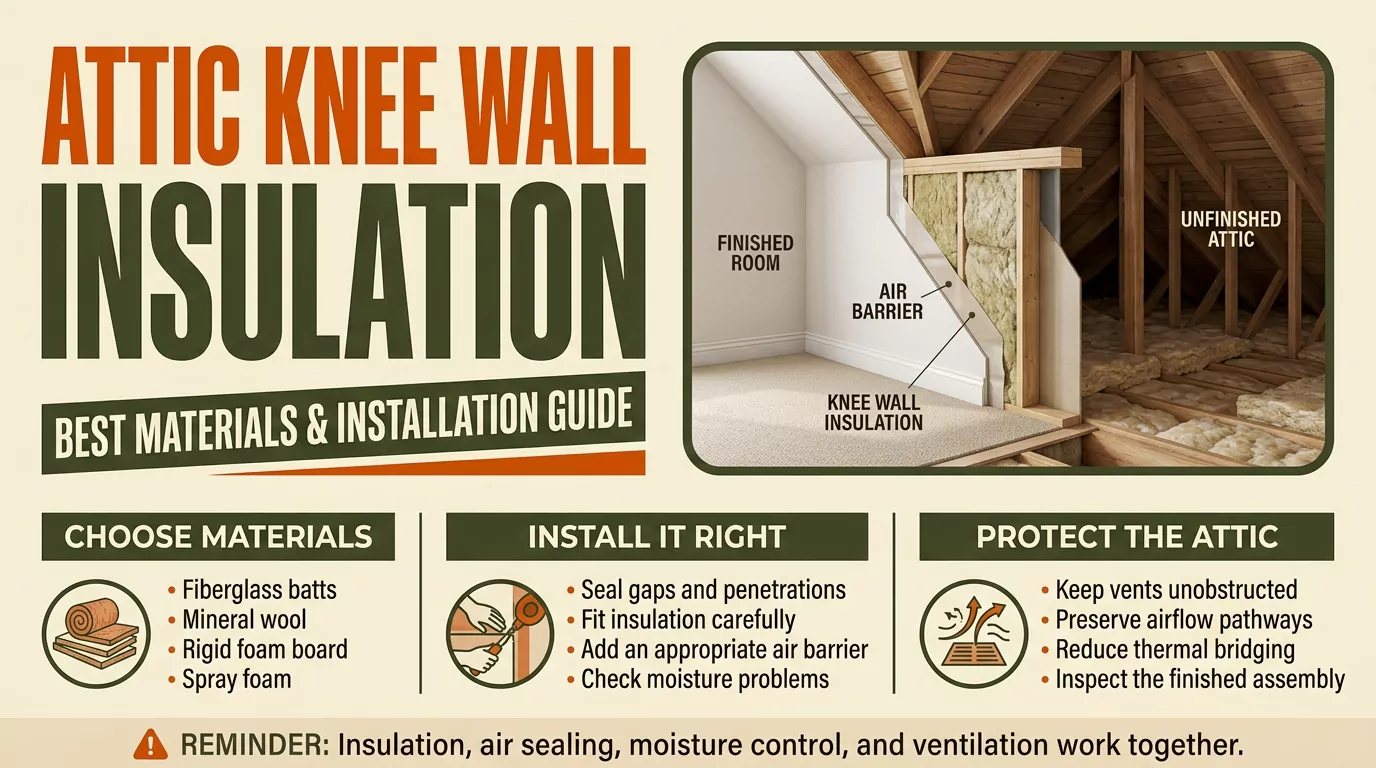
Attic-floor insulation
In a typical vented attic, insulation is commonly placed at the attic floor.
The floor separates conditioned living space from the unconditioned attic.
This keeps the attic outside the home’s conditioned envelope.
Before installing insulation, air leakage through the ceiling should be addressed.
Ventilation pathways must also remain open.
Roofline insulation
Some attic designs place insulation along the roofline.
This changes the location of the home’s thermal boundary.
The attic can become part of the conditioned space when the complete assembly is designed accordingly.
Roofline insulation requires more than simply placing batts against rafters.
The assembly must address:
- Air control
- Moisture control
- Ventilation
- Roof design
- Insulation thickness
- Building code requirements
- Product installation instructions
This is why roofline insulation deserves careful planning.
Attic Ventilation and Mineral Wool
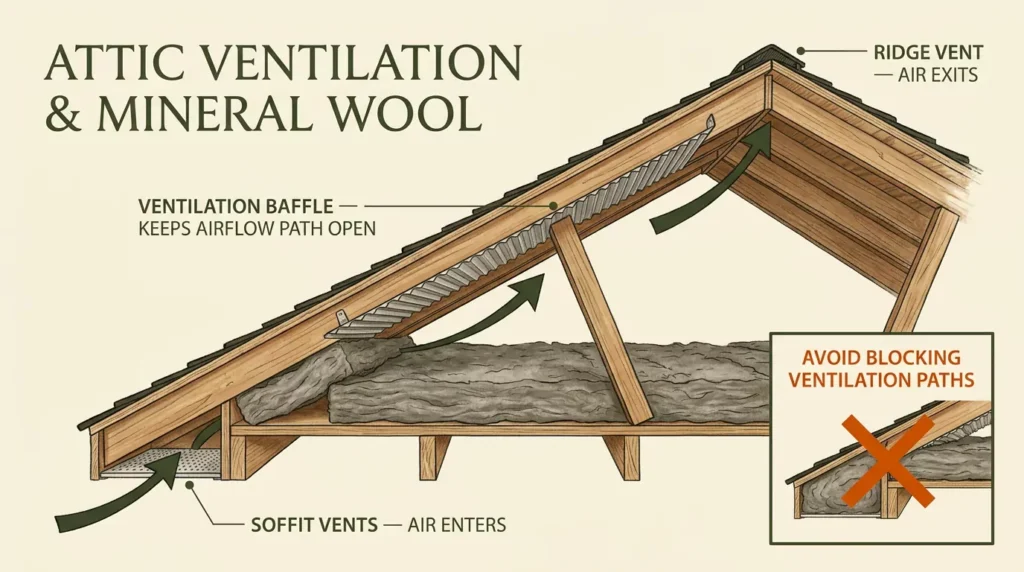
Insulation should not block required attic ventilation pathways.
Many vented attic designs use airflow from soffit areas toward higher roof vents.
Ventilation baffles can help preserve these pathways.
A common installation mistake is pushing insulation into the eaves and blocking airflow.
Before insulating, identify the existing ventilation system.
Look for soffit vents, ridge vents, gable vents, or other designed openings.
The insulation should be installed without damaging the intended airflow path.
How to Install Mineral Wool Attic Insulation
Installation varies by product and attic assembly.
Always follow the manufacturer’s instructions for the specific insulation.
A typical batt installation follows these basic steps.
1. Inspect the attic
Check the attic before installing insulation.
Look for:
- Roof leaks
- Wet materials
- Mold concerns
- Damaged insulation
- Electrical issues
- Air leaks
- Ventilation problems
- Structural concerns
Do not use insulation to hide an existing building problem.
2. Decide whether existing insulation should remain
Existing insulation does not always need immediate removal.
If it is clean, dry, stable, and suitable, adding insulation may sometimes be possible.
Damaged, contaminated, wet, or otherwise unsuitable material may require removal.
The correct decision depends on its condition and the planned assembly.
3. Complete air sealing
Seal important openings between the conditioned space and attic.
This step addresses air movement.
Insulation then performs its separate role of slowing heat transfer.
4. Protect ventilation pathways
Install or maintain appropriate ventilation baffles where needed.
Keep insulation away from designed airflow channels.
5. Measure the cavities
Measure the space between framing members.
Accurate measurements help prevent gaps.
6. Cut the mineral wool
Mineral wool batts can be cut to fit around framing and obstacles.
A suitable serrated insulation knife can help create clean cuts.
The exact cutting method depends on the product.
7. Fit the insulation
Place the batt into the cavity.
The goal is complete coverage without unnecessary compression.
The material should fit the space properly.
8. Check for gaps
Inspect around:
- Framing
- Electrical boxes
- Pipes
- Wiring
- Corners
- Other obstructions
Small gaps can create thermal weak points.
Precise fitting improves insulation continuity.
Common Mineral Wool Installation Mistakes
Even good insulation can perform poorly when installed incorrectly.
Blocking ventilation
Do not block designed soffit or roof ventilation pathways.
Use appropriate baffles where required.
Leaving gaps
Gaps interrupt insulation coverage.
Cut and fit the material around obstacles carefully.
Excessive compression
Do not force batts into spaces that are too small.
Follow product instructions for proper fitting.
Ignoring air leaks
Insulation alone does not solve significant air leakage.
Seal important penetrations and gaps separately.
Covering moisture problems
Never use insulation to hide an active roof leak or condensation issue.
Correct the moisture source first.
Using the wrong product
Not every mineral wool product is designed for every attic application.
Check the product’s intended use, thickness, R-value, and installation requirements.
Mineral Wool R-Value and Thickness
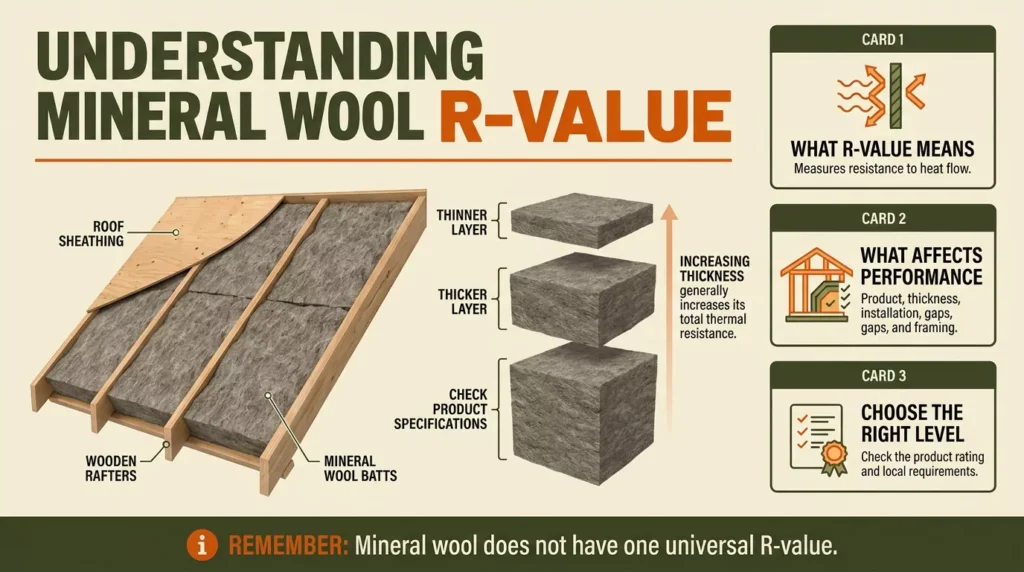
R-value is one of the most important factors when selecting insulation.
However, there is no single R-value for all mineral wool products.
Different products have different ratings.
Thickness also matters.
A thicker insulation layer can provide greater thermal resistance when the product is designed for that application.
The target insulation level should depend on the building, climate, assembly, and applicable requirements.
Do not choose a thickness based only on a generic internet recommendation.
Instead, check the product specification and local requirements.
Mineral Wool vs. Fiberglass
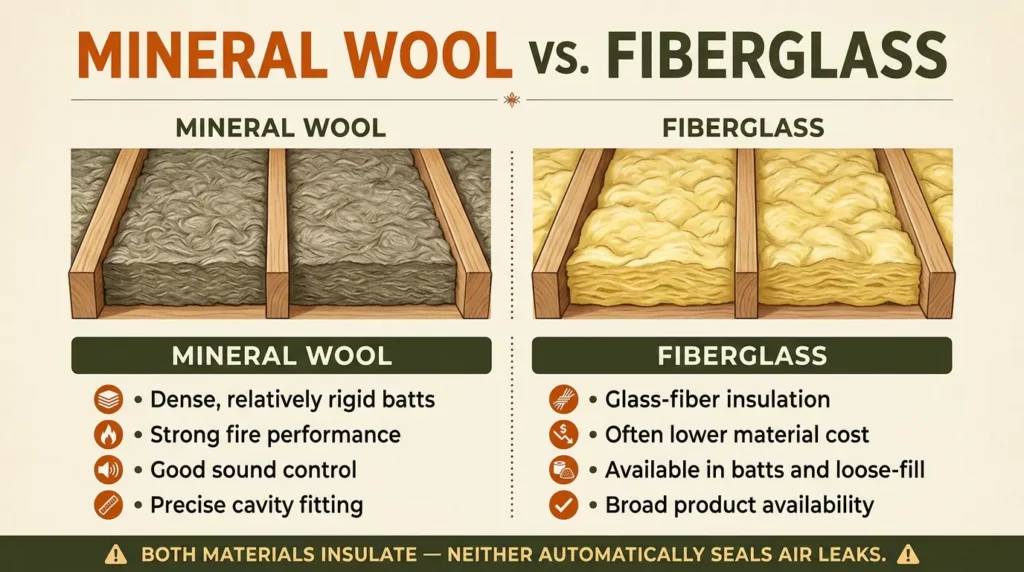
Fiberglass is one of the most common alternatives to mineral wool.
Both materials can provide thermal insulation.
Mineral wool generally has a denser and more rigid structure.
It is also valued for fire performance and sound control.
Fiberglass often has an advantage in material cost and availability.
The better choice depends on the project.
| Feature | Mineral Wool | Fiberglass |
| Fiber type | Mineral fibers | Glass fibers |
| Common formats | Batts and boards | Batts and loose-fill |
| Rigidity | Relatively rigid | Generally less rigid |
| Fire performance | Strong | Varies by product |
| Sound control | Strong | Good |
| Air sealing | No | No |
| Water behavior | Water-resistant fibers | Performance varies with wetting |
| Cost | Often higher | Often lower |
| Fitting | Precise cavity fitting | Available in several installation formats |
Neither material automatically solves air leakage.
Mineral Wool vs. Cellulose
Cellulose is another common attic insulation option.
It is generally installed as loose-fill or dense-packed material.
That format can make cellulose useful for covering irregular attic floors.
Mineral wool batts work differently.
They are preformed products designed for cavity installation.
| Feature | Mineral Wool | Cellulose |
| Main material | Mineral-based fibers | Recycled paper fibers |
| Common attic format | Batts | Loose-fill |
| Cavity fitting | Strong | Depends on installation method |
| Irregular attic coverage | Less convenient with batts | Often well suited |
| Fire performance | Strong | Treated for fire resistance |
| Air sealing | No | No |
| Installation method | Place and fit | Usually blown or dense-packed |
| Main advantage | Density, fire, sound | Loose-fill coverage |
The best choice depends on attic geometry and project goals.
Mineral Wool vs. Spray Foam
Spray foam differs from mineral wool in an important way.
Some spray foam systems can provide both insulation and an air-control layer when correctly installed.
Mineral wool primarily provides thermal insulation.
It does not automatically create the same air-sealing layer.
This makes the two materials different system choices.
Spray foam can also have different costs, installation requirements, and moisture-control considerations.
The right choice depends on the complete building assembly.
How Much Does Mineral Wool Attic Insulation Cost?
There is no universal installed price.
Project cost depends on several factors.
These include:
- Attic size
- Insulation thickness
- Product type
- Required R-value
- Material availability
- Labor
- Attic accessibility
- Existing insulation
- Air-sealing work
- Ventilation work
- Removal requirements
Mineral wool can cost more than basic fiberglass products.
However, material price alone does not determine total project value.
Installation quality, durability, fire performance, sound control, and attic conditions also matter.
Get project-specific pricing before comparing insulation options.
Can You Install Mineral Wool Yourself?
Mineral wool batts can be suitable for capable DIY installers.
The work is more manageable when the attic has accessible framing and straightforward cavities.
You still need proper preparation and protective equipment.
Useful equipment may include:
- Gloves
- Eye protection
- Suitable work clothing
- Appropriate respiratory protection
- Measuring tape
- Marking tools
- Insulation knife
- Lighting
- Knee protection
- Basic hand tools
Follow the product’s safety instructions.
Mineral fibers can irritate the skin, eyes, and respiratory system during handling.
A difficult attic may justify professional installation.
Professional help is especially useful when the project involves complicated roof assemblies, moisture problems, extensive air sealing, electrical concerns, or difficult access.
Should Existing Attic Insulation Be Removed?
Not always.
The condition of existing insulation should be assessed first.
Removal may be appropriate when insulation is:
- Wet
- Mold-affected
- Contaminated
- Severely damaged
- Pest-damaged
- Otherwise unsuitable for the planned assembly
Sound existing insulation may sometimes remain.
The correct approach depends on the existing material and the new insulation plan.
Avoid removing material simply because it is old.
First determine whether it still performs its intended function.
Mineral Wool and Thermal Bridging
Insulation between rafters or joists does not cover every heat path.
Framing members can conduct heat around insulation.
This effect is called thermal bridging.
The impact depends on the framing system and overall assembly.
This is why whole-assembly performance matters.
Increasing insulation thickness can help. Assembly design can also address thermal bridges through additional insulation layers or other strategies.
The correct solution depends on the building design.
Is Mineral Wool Right for Your Attic?
Mineral wool may be a strong option when your project prioritizes:
Fire performance
Mineral wool’s noncombustible mineral fibers make fire performance a major benefit.
Sound control
Its dense structure can help reduce sound transmission.
Rigid cavity fitting
Batts can be easier to position precisely than some flexible insulation products.
Durability
Properly installed mineral wool can provide long-term insulation performance.
Roof-rater applications
Mineral wool batts can work well in suitable rafter and sloped-ceiling assemblies.
It may be less convenient when you need to quickly cover a large, irregular flat attic floor.
In those situations, loose-fill insulation may provide easier coverage.
A Simple Decision Guide
| Your attic situation | Consider |
| Flat, open attic floor | Compare mineral wool with loose-fill options |
| Sloped roof with accessible rafters | Mineral wool batts may work well |
| Strong fire-performance priority | Mineral wool is worth considering |
| Noise-control priority | Mineral wool can be useful |
| Many irregular attic-floor areas | Loose-fill may be easier |
| Major air leakage | Air sealing is needed regardless of insulation |
| Active roof leak | Repair the moisture source first |
| Complex roof assembly | Consider professional assessment |
| Existing insulation is damaged | Evaluate removal before new insulation |
Frequently Asked Questions
What is mineral wool attic insulation?
Mineral wool attic insulation is a fiber-based insulation made from mineral materials. It slows heat transfer through attic floors, walls, and roof assemblies.
Is mineral wool the same as rock wool?
Rock wool is a type of mineral wool. The terms are often used interchangeably in residential insulation discussions. Mineral wool is the broader category.
Is mineral wool good for attics?
Yes, when the product matches the attic assembly. It can work well between rafters, in sloped ceilings, and in suitable attic-floor applications. The best choice depends on attic design and installation requirements.
Does mineral wool stop drafts?
No. Mineral wool provides insulation but does not automatically air seal the attic. Air leaks should be sealed separately.
Does mineral wool absorb water?
Mineral wool fibers resist water absorption. However, mineral wool is not a waterproofing material. A roof leak or condensation problem still requires correction.
Does mineral wool prevent mold?
Mineral wool does not remove the need for moisture control. Persistent moisture can create conditions that support mold growth in a building assembly. The source of moisture should be corrected.
What R-value does mineral wool provide?
R-value varies by product, thickness, and construction. There is no single R-value for all mineral wool insulation. Check the manufacturer’s product specification for the exact rating.
Is mineral wool better than fiberglass?
Neither is universally better. Mineral wool offers strong fire performance, density, and sound-control benefits.
Fiberglass can offer lower cost and broad availability. The right choice depends on the project.
Is mineral wool better than cellulose?
It depends on the attic and installation method. Mineral wool batts can work well in framed cavities. Cellulose loose-fill can be useful for covering irregular attic floors.
Can mineral wool be installed over existing insulation?
It may be possible in some assemblies. First inspect the existing insulation for moisture, contamination, damage, and suitability. The final approach should match the new insulation system.
Can I install mineral wool myself?
Mineral wool batts can be a reasonable DIY project for capable homeowners. However, complex attic assemblies may require professional help. Always follow the product’s installation and safety instructions.
Does mineral wool need attic ventilation?
The answer depends on the attic assembly. A vented attic generally needs its designed ventilation pathways maintained. Insulation should not block required airflow around the eaves.
Should I air seal before installing mineral wool?
In many attic projects, addressing air leakage before insulation is an important step. Insulation and air sealing perform different functions. Air sealing limits uncontrolled airflow, while insulation slows heat transfer.
Final Takeaway
Mineral wool attic insulation is a dense, durable insulation option with strong fire and sound-control properties.
Its effectiveness depends on more than the material itself.
The R-value, insulation thickness, installation quality, air sealing, moisture control, ventilation, and attic design all affect the final result.
For a vented attic, insulation may belong at the attic floor. For a suitable conditioned attic, insulation may instead form part of the roofline assembly.
Before installing mineral wool, inspect the attic and correct moisture problems. Address important air leaks and preserve required ventilation paths.
Then select a mineral wool product designed for your specific application.
That approach produces a better insulation system than simply choosing a material based on its advertised R-value.

Daniel Carter specializes in attic maintenance, insulation, ventilation, moisture control, and home improvement. He understands common attic problems and their practical solutions. Through clear, informative guides, he helps homeowners identify issues, prevent damage, improve energy efficiency, and maintain safer, healthier homes.