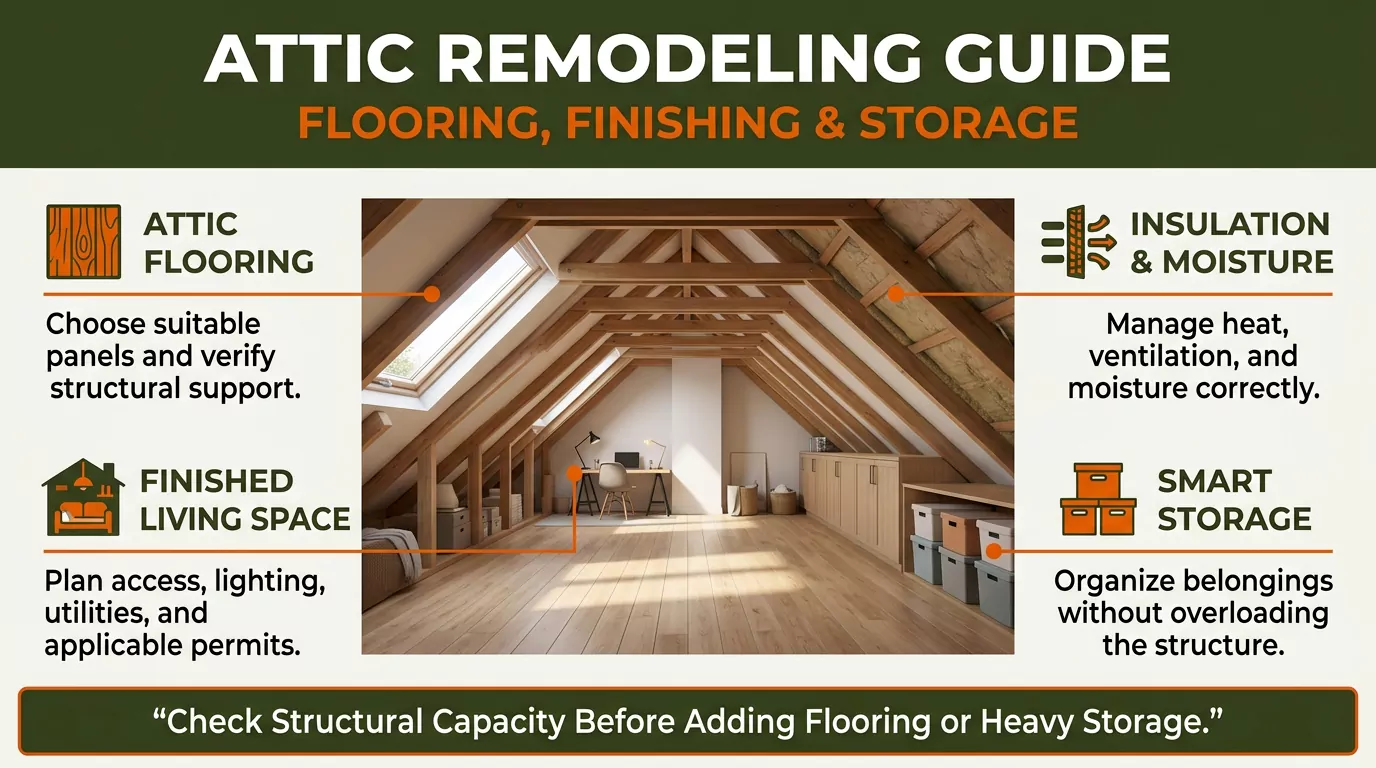
Attic Storage Ideas: Safe and Space-Saving Solutions
The best attic storage ideas combine smart organization with a safe, well-planned layout. Clear storage bins, suitable shelving, raised platforms, and under-eaves storage can help you use more of your available space. However, every storage system must suit the attic’s structure, insulation, access, and environmental conditions.
Before adding boxes or building shelves, check whether your attic can support the intended loads. Ceiling joists and roof trusses are not always designed for storage. Once structural suitability is established, you can organize belongings into zones, protect them from heat and moisture, and make everyday retrieval easier.
This guide explains practical attic storage solutions, unfinished attic organization, flooring considerations, safe access, storage costs, and common mistakes to avoid.
Check Your Attic Before Adding Storage
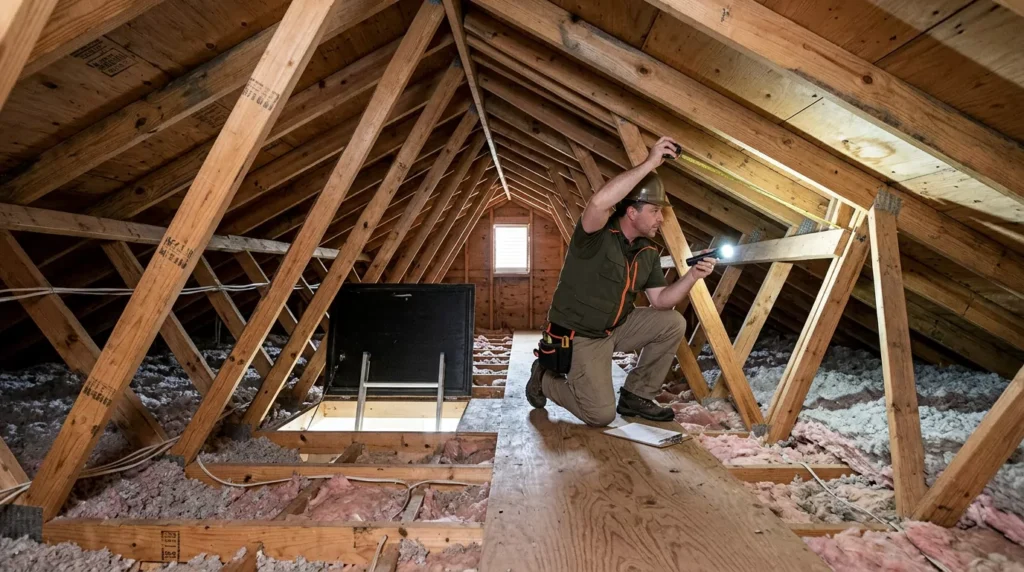
Start by inspecting the attic rather than buying storage products. The condition of the framing, existing insulation, roof, and access point will determine which solutions are appropriate.
Understand attic weight limits
Not every attic can safely support stored belongings. Many ceiling joists primarily support the ceiling and related loads rather than a storage floor. Other attics have structural floor systems designed for greater loads.
Safe capacity depends on several factors:
- Joist or truss design and dimensions.
- Span length and spacing between framing members.
- Wood condition, connections, and existing damage.
- Loads already supported by the structure.
- The weight and placement of proposed storage systems.
Do not assume that adding plywood makes an attic strong enough for heavy storage. Flooring creates a surface, but it does not automatically increase the capacity of the framing underneath.
Roof trusses deserve particular attention. Their interconnected members form an engineered structural system. Cutting, drilling, or modifying those members without appropriate approval can compromise their strength.
If the attic’s capacity is unknown, consult a qualified structural professional before adding substantial storage loads. Do not rely on a general pounds-per-square-foot estimate to approve your individual attic.
Inspect for structural and moisture problems
Look for warning signs before moving belongings inside:
- Sagging or visibly damaged framing.
- Cracked, loose, or deteriorated structural connections.
- Water stains, active leaks, or damp insulation.
- Mold-like growth or persistent musty odors.
- Rodent activity, damaged wiring, or pest entry points.
- Blocked ventilation openings or unsafe electrical conditions.
Some problems may be hidden beneath insulation. Avoid disturbing potentially hazardous materials, including suspected asbestos-containing insulation, until they have been assessed appropriately.
Fix leaks and structural problems before installing storage systems. Covering damaged areas with decking or boxes can make future inspections harder.
Measure the usable storage area
An attic’s total floor area is not the same as its usable storage area. Sloped ceilings, low eaves, framing, ducts, wiring, and access openings can limit what fits.
Measure the available width, length, and headroom. Mark the entrance, any required access routes, and areas that must remain clear.
Then separate the space into three categories:
- Accessible storage: Areas suitable for items you retrieve regularly, subject to structural approval.
- Occasional storage: Approved areas for seasonal belongings and less frequently used items.
- Restricted areas: Locations containing hazards, vulnerable building components, or spaces that are not approved for loading or walking.
This simple assessment prevents you from buying shelves and containers that cannot fit safely.
Best Attic Storage Ideas for Saving Space
The most effective storage system depends on your attic’s layout and the items you need to keep. You do not need to install every option. Choose a few compatible solutions that make belongings easy to reach without compromising the structure.
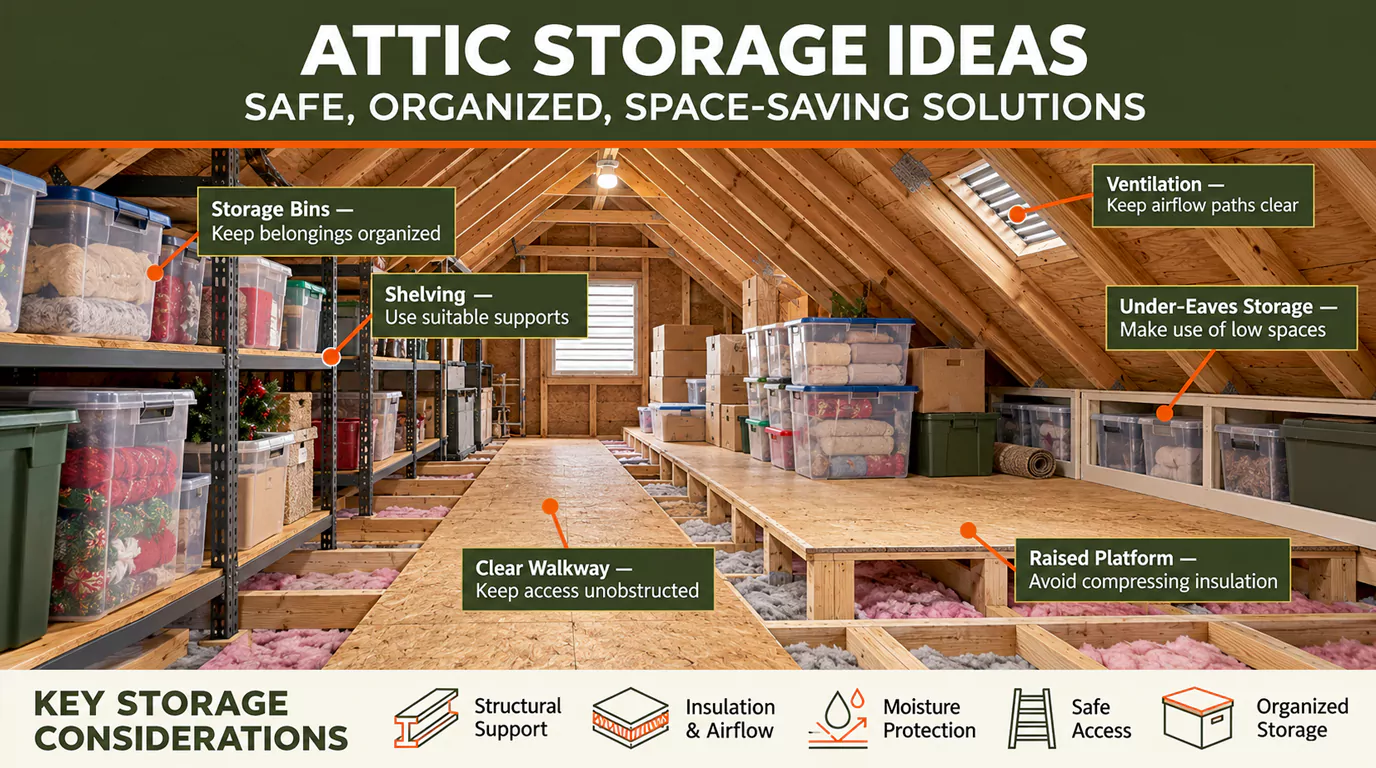
1. Use clear plastic storage bins
Clear plastic bins are useful for seasonal decorations, durable household items, and other belongings that tolerate attic conditions.
They make contents easier to identify and can reduce exposure to dust and pests when properly closed. Stackable designs also help use available height.
Choose bins with secure lids and manageable dimensions. Avoid creating tall, unstable stacks or placing containers where they obstruct walkways, vents, electrical equipment, or inspections.
Label the front of each bin rather than relying only on a lid label. That way, you can identify its contents without moving the entire stack.
Best for: Holiday decorations, camping accessories, durable seasonal gear, and similar belongings.
Limitation: Standard plastic bins are not necessarily airtight or moisture-proof. Sensitive items may require better protection or a climate-controlled location.
2. Install suitable shelving systems
Shelving can keep smaller belongings organized and reduce clutter on accessible floor areas.
Freestanding metal shelving may work where there is adequate clearance and a suitable supporting surface. Wall-mounted shelves can use space along appropriate wall framing. Custom shelving can fit irregular rooflines and narrow areas.
Before installation, verify that the shelf supports, fasteners, mounting surface, and attic structure can handle the intended load. A shelf’s advertised capacity does not establish the capacity of the framing supporting it.
Place frequently used items on reachable shelves. Store lighter belongings higher only when the shelving system and installation allow it. Avoid climbing onto shelves or using them as steps.
Best for: Lightweight containers, craft supplies, durable equipment, and organized collections.
3. Use vertical storage where suitable
Vertical storage makes use of height that might otherwise remain unused. Depending on the attic’s framing and clearance, options include supported shelving, approved wall-mounted organizers, and purpose-built racks.
Keep heavy objects in structurally approved locations. Higher shelves should generally hold lighter items that you can retrieve without stretching or destabilizing a stack.
Do not attach storage hardware to roof trusses, rafters, or other structural members without confirming that the attachment and added load are appropriate. Avoid drilling into concealed wiring or other building services.
Best for: Lightweight seasonal gear, small containers, and belongings that benefit from visible organization.
4. Make use of under-eaves storage
The low spaces beneath sloping roofs often suit compact storage. Shallow bins, low drawers, and appropriately designed cabinets can use these areas without occupying the tallest part of the attic.
Measure the height and depth of each section before selecting containers. Keep the roof and insulation accessible where inspections or maintenance may be needed.
Do not push belongings tightly against the roof sheathing or block required airflow paths. Also avoid placing items directly on insulation.
Best for: Lightweight seasonal clothing, soft goods, small decorations, and other compact belongings suitable for attic conditions.
5. Build raised storage platforms
A raised platform can provide a usable surface above insulation that would otherwise be compressed by conventional decking.
The platform must be designed around the existing structure, intended loads, insulation depth, and required airflow. Its supports must transfer loads to suitable structural members. Raising a platform does not automatically make the attic safe for storage.
Before building one, determine the required insulation depth and identify ventilation paths. Ensure the finished platform will not obstruct roof vents, access to equipment, or important inspection areas.
Best for: Attics where approved storage flooring is needed without reducing insulation depth.
6. Add hooks or hanging organizers
Hooks and hanging systems can hold suitable lightweight items without consuming much floor space. Examples include certain sports accessories, lightweight seasonal decorations, and other belongings designed for hanging.
Use hardware rated for the intended application and attach it only to suitable supporting members. Do not assume a rafter or truss can support an additional hanging load simply because it appears sturdy.
Keep hanging objects clear of wiring, heat-producing equipment, walkways, and access openings.
Best for: Lightweight equipment and belongings that can be securely suspended.
7. Use vacuum storage bags for suitable textiles
Vacuum storage bags reduce the volume of bedding, blankets, and some seasonal clothing. They can make soft goods easier to organize in compact spaces.
However, compression is not appropriate for every textile. Delicate fabrics, structured garments, and items that require special preservation may need different storage methods.
Make sure the textiles are clean and fully dry before packing. Store the sealed bags in a suitable container or protected location, and inspect them periodically for moisture or damage.
Best for: Durable seasonal clothing, blankets, and compatible bedding.
8. Consider overhead storage racks carefully
Overhead racks can free up floor space, but they introduce loads above the storage area. Their suitability depends on the mounting structure, fastening method, installation quality, and intended weight.
Use a purpose-built system with documented load limits. Have a qualified professional assess the installation if the framing capacity or attachment method is uncertain.
Never install an overhead rack simply because the product fits between the rafters. The roof structure may not be designed for that additional load.
Best for: Approved overhead storage locations with suitable clearance and verified structural support.
9. Consider an attic lift for bulky belongings
An attic lift or mechanical platform can move approved loads between floors without requiring someone to carry every item up a ladder.
This may be helpful for frequently used storage areas or bulky belongings. However, a lift does not increase the attic’s floor capacity or make an unsafe structure safe.
Check the equipment’s rated capacity, platform dimensions, travel clearance, installation requirements, and maintenance instructions. The supporting structure and receiving area must also be suitable for the loads involved.
Best for: Suitable homes where moving bulky items through a hatch or stairway is difficult.
10. Create custom storage for unusual spaces
Some attics have awkward corners that do not suit standard shelving or containers. Low drawers, shallow cabinets, and modular organizers can make these areas more useful.
Measure each space carefully and account for the roof slope, framing, access, and inspection requirements. Keep custom storage removable where access to building components may be needed.
Custom storage is most useful when it solves a specific problem rather than filling every available corner.
Best for: Irregular rooflines, narrow spaces, and unusual storage dimensions.
How to Organize an Unfinished Attic
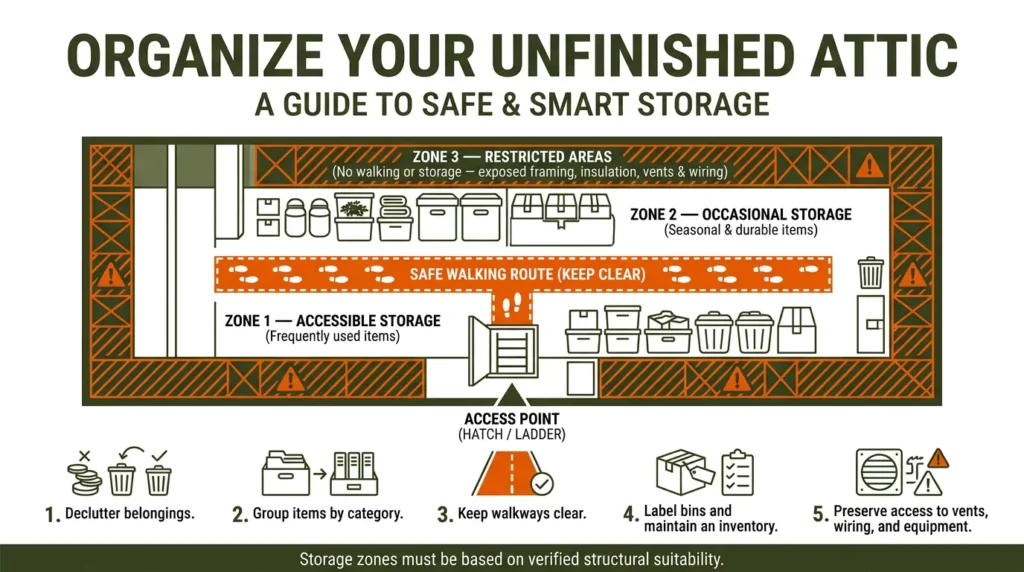
An unfinished attic can still be organized effectively. The key is to plan the layout before placing belongings inside.
Step 1: Declutter before storing
Sort belongings into five groups:
- Keep: Items you use or genuinely need.
- Donate: Useful belongings someone else can use.
- Sell: Items with resale value.
- Recycle: Materials accepted by local recycling programs.
- Discard: Broken or unusable items that cannot be reused.
Be realistic about what deserves storage space. An attic can become crowded when it holds items that no longer serve a purpose.
Do not store anything until you know where it belongs and whether the attic conditions are suitable.
Step 2: Divide the attic into storage zones
Group belongings by category and how often you use them.
| Storage zone | Suitable examples | Placement principle |
| Seasonal items | Holiday decorations and seasonal accessories | Accessible approved areas |
| Outdoor gear | Camping equipment and durable sports accessories | Suitable space with adequate clearance |
| Clothing and textiles | Compatible seasonal clothing and bedding | Protected from heat and moisture |
| Keepsakes | Durable personal belongings | Protected containers in suitable conditions |
| Long-term storage | Items rarely needed | Approved areas that remain safely accessible |
The table provides organizational examples, not approval to place heavy belongings in any particular location. Structural suitability comes first.
Keep frequently retrieved items near the access point when practical. Place less frequently used belongings farther away only if the route and storage location are safe.
Step 3: Keep walkways clear
A useful storage layout lets you reach belongings without climbing over boxes or stepping onto exposed framing.
Provide a suitable walking surface wherever movement is necessary. Do not step between ceiling joists or onto insulation. Keep paths clear of cables, tools, hanging items, and loose materials.
Do not create a narrow route that forces you to carry bulky containers through an unstable area. If safe movement is not possible, change the layout or seek professional advice about improving access.
Step 4: Label containers and maintain an inventory
Labels should identify both the category and the contents. For example, use “Winter coats and gloves” rather than a vague label such as “Clothes.”
A basic inventory can include:
- Container number.
- Main contents.
- Storage category.
- Approximate location.
- Date stored.
- Any special handling or environmental requirements.
For a small attic, a notebook may be enough. Larger spaces may benefit from a spreadsheet with a simple zone map.
Update the inventory whenever you add, remove, or relocate belongings. This reduces unnecessary searching and helps prevent duplicate purchases.
Step 5: Plan for future access
Think about how you will retrieve each item before storing it. A container that fits perfectly into a tight corner may be difficult to remove later.
Choose manageable container sizes. Avoid storing heavy or awkward items where retrieval requires reaching across unstable surfaces.
Leave access to equipment, wiring, vents, and areas that require periodic inspection. Organization should simplify maintenance, not hide building problems.
Attic Flooring and Insulation Considerations
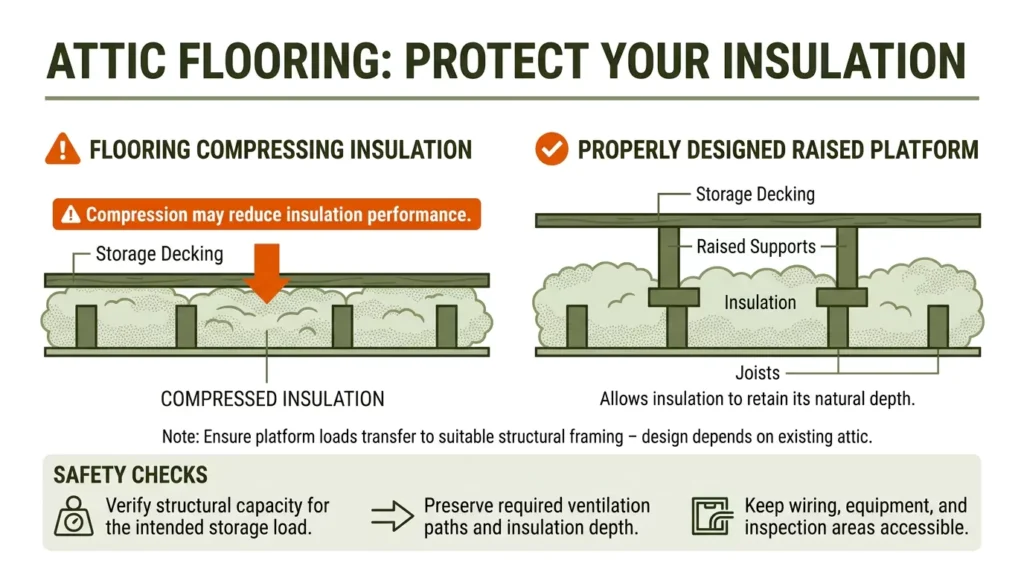
Flooring can improve attic usability, but it must be appropriate for the existing structure and insulation.
Can you put plywood over attic joists?
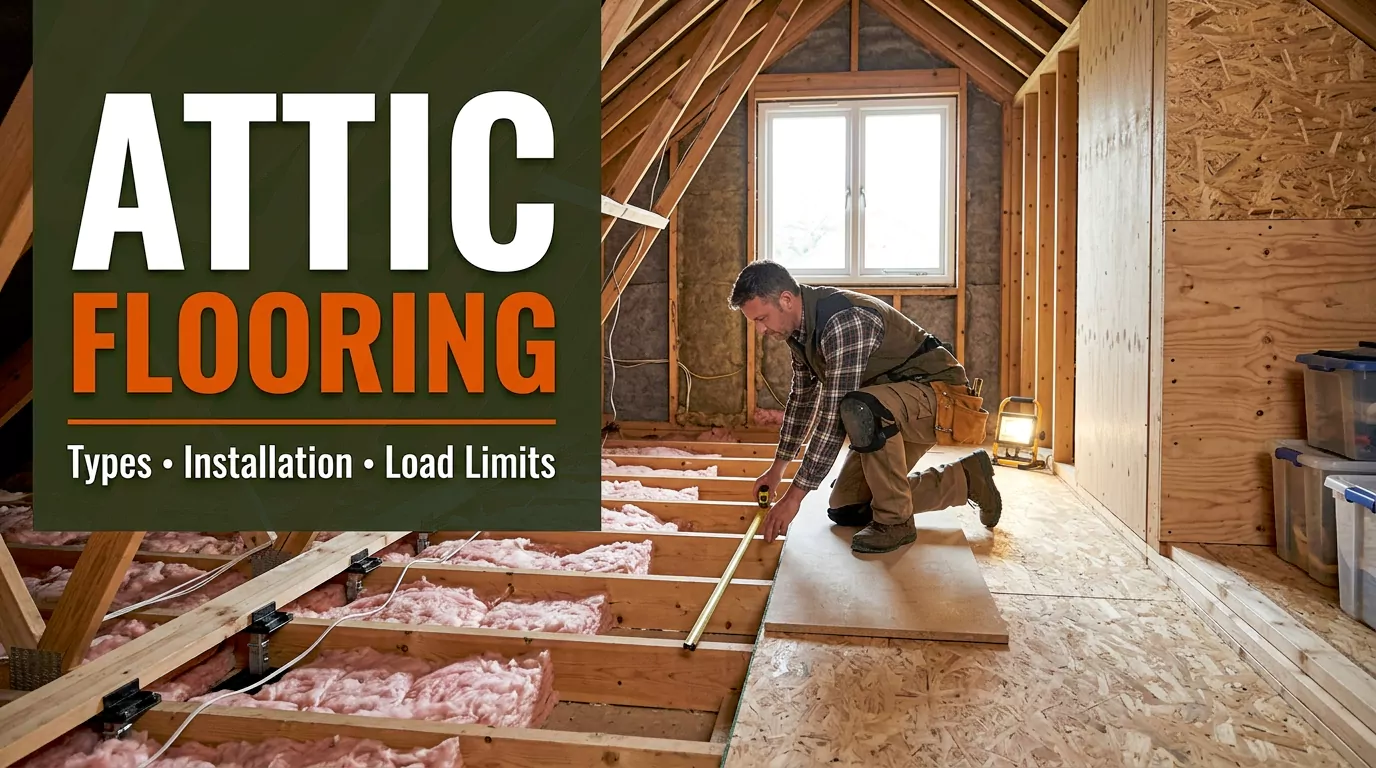
Plywood or oriented strand board (OSB) can form a storage surface when the supporting structure is suitable. The panel thickness, support spacing, fastening method, and intended use must match the actual conditions.
Do not assume that any sheet material placed over exposed joists creates a safe storage floor. Confirm structural capacity before installation.
Protect insulation when adding flooring
Attic insulation slows heat transfer between the living space and the roof. Its effectiveness depends on factors such as material type, thickness, installation quality, and the absence of unwanted gaps.
Laying decking directly over deep loose-fill insulation can compress it. Compression may reduce its effective thermal resistance and interfere with the intended insulation arrangement.
A properly designed raised platform can help preserve insulation depth. However, the platform must still be structurally suitable, and its installation must preserve required ventilation and access.
Before proceeding:
- Identify the insulation type and existing depth.
- Determine the insulation level appropriate for the home and local requirements.
- Locate soffit, ridge, or other ventilation openings where present.
- Check for ducts, wiring, and equipment that require clearance.
- Plan a suitable platform or other storage arrangement.
- Obtain professional guidance if the structural or insulation design is unclear.
Do not cover vents or compress insulation to gain a few extra inches of storage.
5. Make Attic Access Safer and Easier
Access affects how conveniently you can use storage and how safely you can move belongings.
Attic hatches
A basic hatch may work for occasional access and small containers. Keep the opening clear and use a stable, appropriate ladder.
Where the hatch separates conditioned living space from the attic, an appropriate insulated and sealed cover can help maintain the building’s thermal boundary. The correct details depend on the attic design and local requirements.
Pull-down attic ladders
A folding ladder can make an attic easier to reach without using a separate portable ladder every time.
Check the opening dimensions, ladder rating, installation instructions, and condition of the surrounding framing. The ladder’s weight rating applies to the ladder itself, not the attic floor.
Never exceed the manufacturer’s limits or carry a load that prevents you from maintaining safe contact and balance.
Permanent stairs
Permanent stairs may be suitable for an attic used frequently or converted into a more functional space. They require adequate room and may involve structural changes, building approvals, and professional installation.
They are not necessary for every storage attic. Compare the space and cost requirements with how often you will use the area.
Lighting and safe movement
Good lighting helps you see framing, containers, labels, and possible hazards. Suitable fixed lighting or approved portable lights may improve visibility.
Electrical work should follow applicable requirements. Do not leave hot or unsuitable light fixtures buried under stored belongings.
For bulky items, consider splitting loads into smaller containers or using a properly installed lift. Do not climb a ladder while handling a load that blocks your view or compromises your balance.
What to Store and What to Keep Elsewhere
An attic’s temperature and moisture conditions can be harsher than those inside the main living area. Choose belongings based on the actual environment rather than assuming every item will remain safe in storage.
Items that may suit attic storage
If the attic is dry, free of pests, and structurally suitable, it may accommodate:
- Durable holiday decorations.
- Suitcases and travel accessories.
- Suitable camping gear.
- Artificial decorations and trees.
- Robust household accessories.
- Seasonal items that tolerate temperature changes.
- Compatible clothing and bedding stored in clean, dry conditions.
Even these items can be damaged by persistent moisture, pests, or extreme heat. Inspect them before storage and periodically afterward.
Items that may need another location
Unconditioned attics can experience significant temperature and humidity fluctuations. Consider keeping the following in a more stable indoor environment:
| Item | Main concern | Better approach |
| Electronics | Heat and moisture can damage components | Store in a suitable indoor environment |
| Photographs and important documents | Heat and humidity can cause deterioration | Use appropriate archival storage in a stable environment |
| Artwork and delicate keepsakes | Environmental changes can damage materials | Choose controlled conditions suited to the item |
| Candles and wax products | High temperatures can soften or deform wax | Store in a cooler, suitable location |
| Delicate fabrics | Heat, moisture, pests, and creasing | Use suitable textile storage conditions |
| Food, pet food, and seed | Heat and pests can create spoilage or infestation risks | Use an appropriate, controlled storage area |
| Flammable or hazardous products | Heat, ignition sources, and unsafe storage conditions | Follow product labels and applicable safety requirements |
Wood furniture, records, photographs, and other sensitive possessions may also need a more stable environment. The right choice depends on their materials and preservation needs.
Protect belongings from moisture and pests
Before storing items, fix active leaks and address persistent condensation. A sealed bin cannot solve an underlying moisture problem.
Use containers suited to the items and the conditions. Keep belongings dry before packing them, and avoid storing food or materials that attract pests.
Inspect for droppings, nesting material, chewed packaging, and new openings. Address pest entry points safely rather than relying only on repellents or storage containers.
Attic Storage Costs and Budget Planning
The cost of organizing an attic depends on the size of the space, its current condition, the materials selected, and whether professional work is required.
A small organization project may need only bins, labels, and basic lighting. A project involving flooring, raised platforms, access improvements, structural repairs, or a mechanical lift can cost considerably more.
| Expense category | What affects the cost |
| Storage bins and labels | Container size, quantity, durability, and lid design |
| Shelving and organizers | Material, dimensions, load rating, and installation |
| Flooring or decking | Panel material, area, framing condition, and installation method |
| Raised platforms | Required height, support design, insulation depth, and labor |
| Attic access | Hatch changes, ladder type, opening size, and installation |
| Lighting | Fixture type, wiring, electrical access, and labor |
| Attic lift | Rated capacity, equipment model, installation, and structural requirements |
| Professional assessment | Scope of inspection, accessibility, and any required follow-up work |
Request current local quotes before setting a budget. Material prices and labor rates vary by location and project conditions.
How to keep an attic storage project affordable
Start with the existing space if it is safe and suitable. Declutter before purchasing containers, measure before ordering shelves, and choose storage products that fit your actual needs.
Avoid spending money on decorative organization before resolving leaks, pests, insulation problems, or structural concerns.
A sensible order is to assess the attic, address necessary repairs, plan safe access, establish suitable storage surfaces, and then purchase containers and organizers.
Attic Storage Safety Checklist and Maintenance
Use this checklist before moving belongings into the attic.
- Structural capacity has been assessed where needed.
- Damaged framing and moisture problems have been addressed.
- Flooring and platforms are suitable for their intended use.
- Insulation depth and required airflow paths are preserved.
- Storage systems have suitable supports and secure attachments.
- Containers and belongings do not obstruct walkways or access openings.
- Lighting provides adequate visibility.
- Electrical equipment, heat sources, and required service areas remain accessible.
- Stored items suit the attic’s environmental conditions.
- Heavy or awkward items can be moved without unsafe lifting or climbing.
- Labels and an inventory identify stored belongings.
- A routine inspection schedule is in place.
Maintain the system over time
Inspect the attic periodically and after events that may have affected the roof or building, such as a significant leak or storm.
Look for new stains, damp insulation, pests, damaged containers, shifted stacks, loose hardware, and blocked vents. Recheck access routes and remove belongings that are no longer needed.
If you notice sagging, new structural cracks, unusual movement, or other signs of possible structural damage, stop using the affected area and seek a qualified assessment.
An organized attic should remain easy to inspect. Avoid packing it so tightly that you cannot reach important building components or recognize developing problems.
Frequently Asked Questions
What are the best attic storage ideas?
Clear plastic bins, suitable shelving, under-eaves storage, labeled zones, and raised platforms are useful options. Choose systems that fit your attic’s structure, insulation, access, and environmental conditions.
How much weight can an attic hold?
There is no single safe weight limit for every attic. Capacity depends on framing design, span, condition, connections, existing loads, and how additional weight is distributed. A qualified structural professional can assess an attic when its capacity is unknown.
Can I put plywood over attic joists for storage?
Sometimes, but only when the supporting structure is suitable for the intended loads. Plywood creates a surface; it does not automatically strengthen the joists. Installation must also account for insulation, ventilation, and access.
How can I add attic storage without compressing insulation?
A properly designed raised platform can create space above insulation. Its supports must transfer loads to suitable structural members, and the installation must preserve required insulation depth, ventilation, and access.
What containers are best for attic storage?
Rigid plastic bins with secure lids are useful for many durable belongings. Choose containers according to the contents and environmental conditions. Standard bins do not guarantee protection against all moisture or temperature problems.
What should you avoid storing in an attic?
Avoid storing heat-sensitive electronics, delicate photographs, important documents, wax products, and other vulnerable belongings in an attic with extreme temperature changes. Food and hazardous materials may also be unsuitable. Choose storage conditions based on the item and its safety requirements.
How do I maximize storage under a sloped roof?
Measure the available height and use suitable shallow bins, low drawers, or custom storage. Keep required ventilation paths clear and preserve access to framing and building services. Store items only in structurally approved areas.
Are attic lifts worth installing?
An attic lift may help when you regularly move bulky items or struggle with safe ladder access. Consider its cost, rated capacity, installation requirements, and supporting structure. A lift improves material handling but does not increase the attic’s structural capacity.
How often should I inspect attic storage?
Inspect the attic periodically and after significant roof leaks, storms, or other events that may cause damage. Check for moisture, pests, structural changes, blocked ventilation, and unstable storage arrangements. Address problems promptly.
Conclusion
The best attic storage system makes unused space more useful without compromising structural safety or building performance. Start by checking the attic’s condition, understanding its load-bearing limitations, and planning around insulation and access.
Then choose practical solutions such as clear bins, suitable shelving, under-eaves storage, or raised platforms. Organize belongings into labeled zones and keep walkways and inspection areas accessible.
Store only items that can tolerate the attic’s conditions, and review the system regularly. With careful planning, you can create an organized, convenient storage area without turning the attic into a safety or maintenance problem.

Daniel Carter specializes in attic maintenance, insulation, ventilation, moisture control, and home improvement. He understands common attic problems and their practical solutions. Through clear, informative guides, he helps homeowners identify issues, prevent damage, improve energy efficiency, and maintain safer, healthier homes.