Wasps in Attic: Signs, Removal, Risks & Prevention
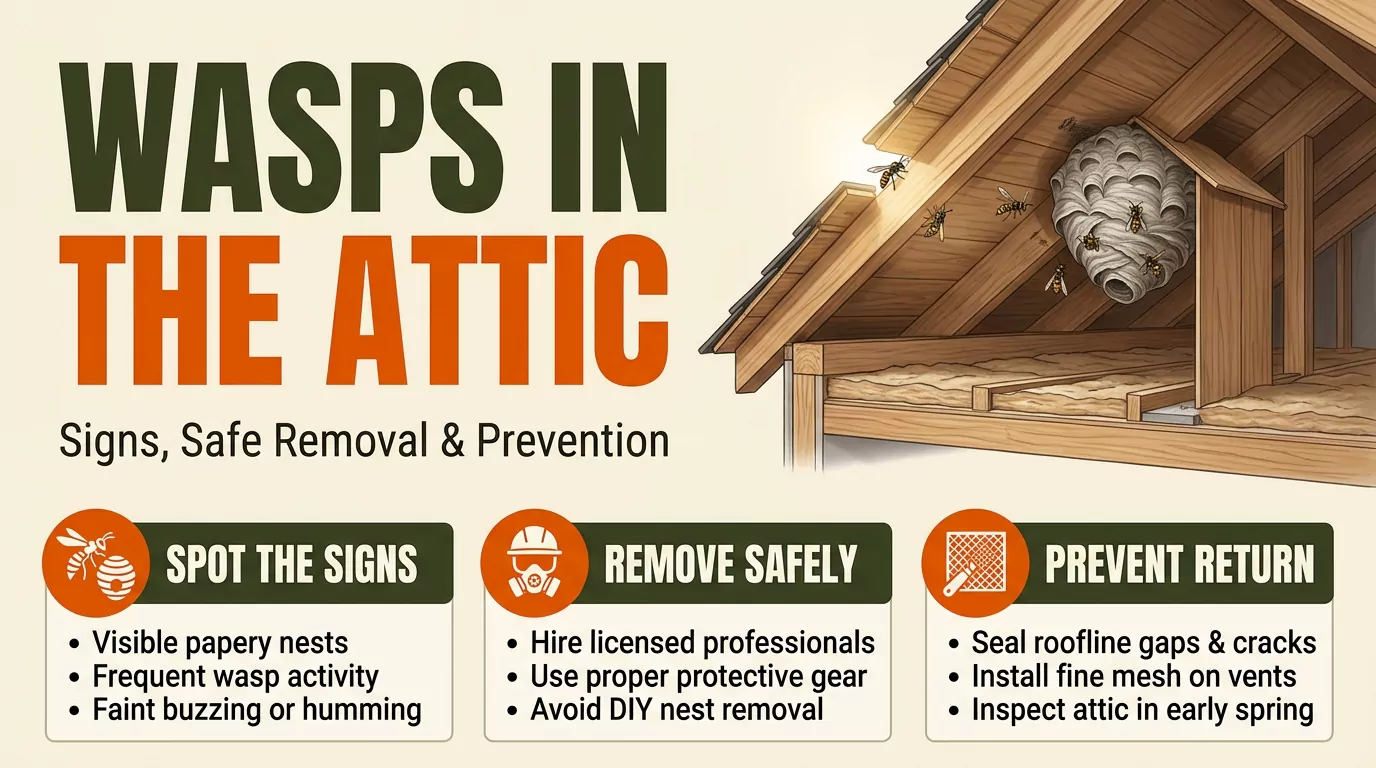
Wasps in an attic can create a serious safety concern, especially when their nest is hidden. The safest solution depends on the wasp species, nest location, and colony size. If you hear buzzing or notice wasps entering your roofline, avoid disturbing the area.
Small, exposed nests may sometimes be manageable under appropriate conditions. However, concealed nests inside attics, ceilings, or wall cavities often require professional pest control. This guide explains how to identify wasps, understand the risks, arrange safe removal, and prevent future infestations.
What Should You Do If You Find Wasps in Your Attic?
If you suspect wasps in your attic, keep people and pets away from the area. Do not climb into a space with active buzzing or attempt to locate a hidden nest.
Follow these precautions:
- Stop using the attic access if wasps appear active nearby.
- Keep children and pets away from the suspected nesting area.
- Observe wasp activity from a safe distance without blocking their flight path.
- Look for repeated entry through roof gaps, soffits, or exterior vents.
- Contact a pest control professional if the nest appears concealed, large, or difficult to reach.
Avoid sealing an opening while wasps are still active. Trapped wasps may find their way into living spaces through ceiling gaps or other openings.
If someone has a known severe sting allergy, take extra care to prevent exposure. Seek professional assistance rather than attempting nest removal yourself.
Signs of a Wasp Infestation in the Attic
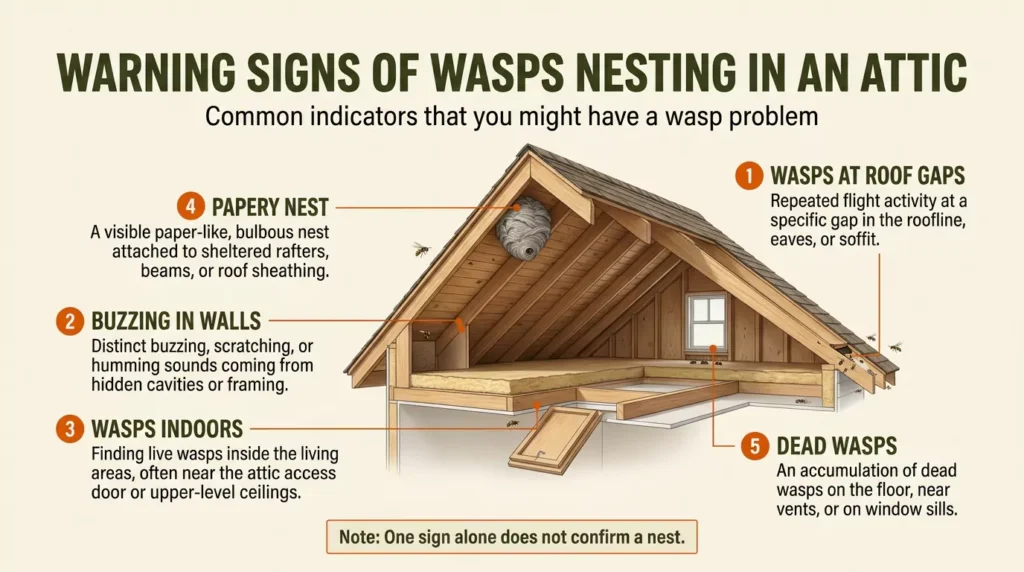
Wasps can establish colonies without being noticed for weeks. Recognizing early warning signs helps you address the problem before the colony grows.
However, one sighting does not automatically mean a nest exists inside your attic. Look for several signs that point toward the same location.
1. Wasps Entering and Leaving the Same Opening
Repeated flight activity around one roof gap is a strong clue. Wasps may enter through soffits, roof edges, damaged vents, or gaps near fascia boards.
Watch from a safe distance and note where the insects disappear. Avoid standing directly beneath their flight path.
A steady stream of wasps entering one opening suggests a possible nest inside the structure. A pest control professional can investigate the likely location.
2. Buzzing Sounds From the Ceiling or Walls
Persistent buzzing may indicate wasps moving inside a concealed cavity. You might hear the sound near attic rafters, ceiling spaces, or exterior walls.
However, buzzing is not definitive proof of a wasp colony. Other insects, electrical equipment, and building components can produce similar sounds.
Do not tap the wall, drill holes, or remove drywall to investigate. These actions can disturb an active colony and increase sting risks.
3. Wasps Appearing Inside Your Home
Repeated wasp sightings indoors deserve attention, especially when they occur near ceilings, light fixtures, or attic access points.
Wasps may enter through damaged screens or open doors. Others may emerge from gaps connecting the attic or wall cavities to living spaces.
Finding several wasps indoors does not establish the nest’s exact location. A professional inspection can help identify their entry route.
4. Visible Nests or Papery Material
Some wasp nests hang openly from rafters, roof structures, or sheltered corners. Others remain hidden behind insulation, roofing materials, or wall coverings.
Many social wasps build nests from chewed wood fibers mixed with saliva. This material forms a paper-like structure.
Do not approach a suspected nest to inspect its shape. Observe it from a safe distance and arrange professional identification when necessary.
5. Dead Wasps Near Windows or Attic Access Points
Dead wasps may appear near windows, skylights, or attic access doors. Their presence can indicate that insects entered the building accidentally or emerged from a nearby cavity.
Repeated findings deserve further investigation. However, dead wasps alone do not prove that an active nest exists inside the attic.
Why Do Wasps Build Nests in Attics?
Wasps seek protected places where their colonies can develop with limited disturbance. Attics offer shelter from rain, wind, and many predators.
Different species choose different nesting locations. Some build exposed nests beneath roof edges, while others establish colonies inside enclosed cavities.
Common reasons include:
- Shelter: Roof structures protect nests from harsh weather.
- Undisturbed spaces: Quiet attic corners offer suitable nesting locations.
- Access through small gaps: Openings around rooflines allow wasps to enter.
- Protected cavities: Wall and ceiling voids conceal nests from view.
- Suitable surroundings: Nearby plants and insects can provide food.
Wasps do not necessarily prefer dirty or poorly maintained attics. Even well-kept homes can have small structural openings that allow nesting.
Common Wasp Entry Points
Inspect the building exterior visually rather than entering a potentially infested attic.
| Entry point | Why it matters |
| Soffits and eaves | Gaps may connect directly to roof spaces |
| Roofline and fascia boards | Loose or damaged sections can create openings |
| Gable and roof vents | Missing or damaged screening may allow entry |
| Siding gaps | Open joints may provide access to wall cavities |
| Utility penetrations | Gaps around cables and pipes can provide entry routes |
| Damaged roof sections | Openings may connect exterior spaces with the attic |
Do not cover functional vents simply to exclude insects. Repairs must preserve the ventilation required by the building.
Types of Wasps That May Nest in Attics
Identifying the likely species helps determine the appropriate response. However, appearance alone may not reveal the exact nest location or colony size.
| Wasp type | Common appearance | Typical nesting behavior |
| Paper wasps | Slender bodies and long legs | Build exposed, open-comb nests beneath sheltered surfaces |
| Yellowjackets | Compact bodies with yellow and black markings | May nest underground or inside wall and roof cavities |
| Hornets | Generally larger wasps, depending on species | Some build enclosed, papery nests in protected locations |
| Mud daubers | Slender bodies, often dark-colored | Build individual mud cells on sheltered surfaces |
Paper Wasps
Paper wasps commonly build small, exposed nests under eaves, porch roofs, and sheltered roof structures.
Their nests have visible cells rather than a fully enclosed outer covering. These nests may be easier to identify than colonies hidden inside building cavities.
Paper wasps can still sting when threatened. Do not assume an exposed nest is safe to remove without assessing its location and activity.
Yellowjackets
Yellowjackets can become particularly defensive when their colony is disturbed. Some species establish nests in enclosed structural spaces.
A concealed colony may produce repeated indoor sightings or buzzing near walls and ceilings. Spraying the exterior opening may not eliminate insects deeper inside the structure.
Hidden yellowjacket nests are best assessed by a pest control professional.
Hornets
Some hornets build enclosed, paper-like nests in trees, shrubs, or sheltered building locations. Their behavior and nest placement vary by species.
A nest inside or near a roof structure can be difficult to reach safely. Avoid climbing ladders or opening building materials to investigate it.
If you cannot confidently identify the insect, seek professional identification before choosing a treatment.
Are Wasps in the Attic Dangerous?
Yes, an active wasp colony can pose a significant safety risk. The greatest concern is disturbing the nest and triggering defensive behavior.
Attic spaces make encounters more dangerous because escape routes may be narrow. Low ceilings, insulation, exposed framing, and limited lighting can also make movement difficult.
Wasp Stings and Allergic Reactions
A wasp sting commonly causes localized pain, redness, itching, and swelling. The severity varies between individuals.
Some people experience severe allergic reactions called anaphylaxis. Warning signs may include:
- Difficulty breathing or wheezing
- Swelling of the tongue or throat
- Fainting, collapse, or severe dizziness
- Widespread hives accompanied by other serious symptoms
Suspected anaphylaxis is a medical emergency. Call your local emergency number immediately and use prescribed epinephrine if available, following the person’s emergency plan.
Do not wait for symptoms to worsen. Anyone experiencing a severe reaction needs urgent medical care.
Risks to Children and Pets
Children may not recognize a nest or understand why they should avoid flying insects. Pets can also disturb nests while exploring roof access areas or nearby outdoor spaces.
Keep children and animals away from suspected nesting locations. Avoid allowing pets into affected areas until the colony has been safely addressed.
If wasps enter occupied rooms, keep people away from the affected area and arrange appropriate assistance.
Can Wasps Damage an Attic?
Wasp nesting does not automatically mean the building has suffered major structural damage.
However, colonies can occupy building cavities, and removing nests may expose damaged screens, gaps, or other maintenance issues. Improper removal can also damage insulation, drywall, or roof components.
A professional inspection can determine whether repairs or insulation replacement are necessary. Avoid assuming that all affected materials must be removed.
How to Get Rid of Wasps in an Attic Safely
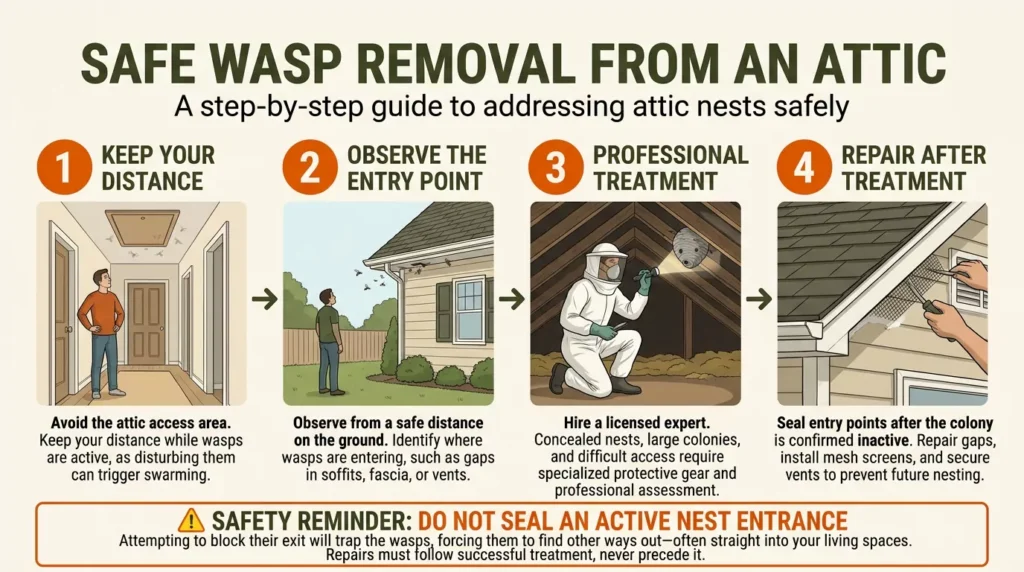
The safest removal method depends on whether the nest is exposed or concealed. Large colonies, hidden nests, and difficult access generally require professional treatment.
Step 1: Avoid Disturbing the Nest
Do not enter a buzzing attic or approach an active colony. Avoid tapping walls, moving insulation, or opening suspected nesting cavities.
These actions can provoke defensive behavior before you understand the colony’s location.
Keep the attic access closed if doing so does not require approaching active wasps. If insects are already entering living spaces, move away from the affected area and seek assistance.
Step 2: Observe Exterior Activity From a Safe Distance
If you can do so without approaching the insects, observe the roofline from the ground.
Look for repeated wasp traffic near soffits, vents, fascia boards, and roof intersections. Note the approximate location for the pest control professional.
Do not climb onto the roof or use a ladder to follow wasps. Avoid blocking the entrance or attempting to confirm the nest by opening the structure.
Step 3: Determine Whether the Nest Is Exposed or Concealed
An exposed nest may be visible beneath a rafter or sheltered roof edge. A concealed colony may sit behind insulation, inside a wall cavity, or beneath roofing materials.
This distinction affects treatment.
Surface sprays may kill exposed insects without reaching the nest’s interior. Treatments for concealed colonies require an assessment of the cavity, access point, and pesticide suitability.
Step 4: Arrange Appropriate Treatment
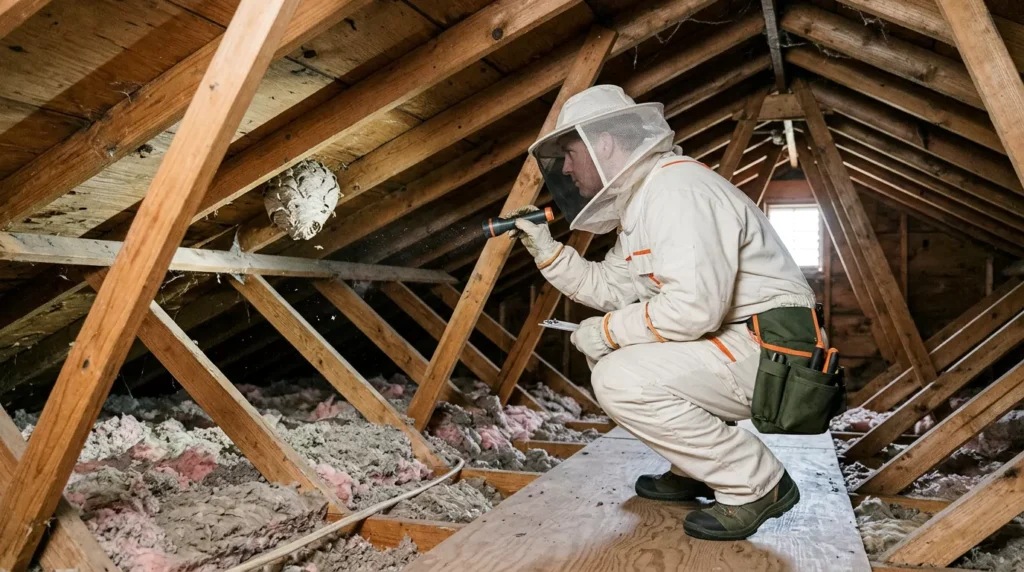
For concealed nests, large colonies, or nests in hazardous locations, contact a qualified pest control professional.
Depending on the situation, the professional may:
- Identify the wasp species and likely nest location.
- Assess the colony’s activity and accessibility.
- Select an appropriate, labeled treatment.
- Treat the colony using suitable equipment and precautions.
- Arrange follow-up checks to confirm the activity has stopped.
- Recommend repairs to prevent future entry.
The treatment method varies by species and structure. Not every infestation requires the same pesticide or removal procedure.
Step 5: Confirm the Colony Is Inactive
Do not assume a nest is inactive simply because you see fewer wasps.
Some insects may remain inside the nest, while others may continue entering and leaving the cavity. Follow the professional’s instructions for monitoring and confirming treatment success.
Avoid removing a nest or disturbing insulation before it is safe to do so.
Step 6: Remove the Nest and Repair the Area When Appropriate
Nest removal may be unnecessary for some abandoned, inaccessible nests that pose no ongoing hazard. However, a professional may recommend removal when the nest obstructs repairs or creates another practical concern.
Once the colony has been dealt with, inspect the area for damaged screening, gaps, or affected materials.
Complete suitable repairs without blocking required ventilation. This helps reduce the chance of another colony establishing itself nearby.
Can You Use Wasp Spray Inside an Attic?
Using wasp spray inside an attic is not automatically safe or effective. Many products are designed for specific locations and applications.
Attics may contain insulation, electrical equipment, stored items, and limited ventilation. Applying the wrong product can expose occupants to pesticide residues or create other hazards.
Before considering any pesticide, check its label for approved use sites, application directions, protective equipment, and re-entry precautions.
Avoid using a product in a location that its label does not permit.
Why Wasp Foggers May Not Work
A total-release fogger disperses pesticide into the surrounding air. It may not deliver an effective treatment deep inside a concealed nest.
The nest could remain active even after exposed insects have died. Foggers may also contaminate attic materials without solving the underlying problem.
Do not use smoke, fire, or improvised chemical mixtures to force wasps out. These methods can create additional health, fire, or property hazards.
Do Wasp Traps Work in Attics?
Wasp traps can capture some insects, but they rarely eliminate an established colony by themselves.
A trap may reduce the number of individual wasps caught near an outdoor area. It does not necessarily reach the queen, brood, or hidden nest.
Use traps only where appropriate for the identified pest. Do not place them inside a confined attic as a substitute for proper nest treatment.
Should You Remove a Wasp Nest or Leave It Alone?
Not every nest requires immediate removal. Some wasp species help control other insects and may pose little risk when nesting away from people.
A nest in an inaccessible location may be left undisturbed when it presents no meaningful hazard. The decision should consider its species, location, activity, and proximity to occupied spaces.
Removal is more likely to be appropriate when:
- Wasps enter living areas repeatedly.
- The nest is close to an attic hatch or frequently used space.
- Children, pets, or vulnerable occupants face an exposure risk.
- The colony occupies a cavity that needs repair.
- The nest is inaccessible and could provoke defensive behavior.
In cooler climates, many social wasp colonies die off during fall or winter. New queens may survive and establish colonies the following year.
Old nests generally are not reused, although favorable nesting sites may attract new colonies. Seasonal behavior varies by species and local climate, so waiting is not appropriate for every situation.
How Much Does Professional Wasp Removal Cost?
Professional wasp removal costs vary by location, colony size, access, treatment method, and repair needs.
An exposed nest that is easy to reach may require less work than a colony concealed inside a roof or wall cavity.
| Cost factor | How it affects the service |
| Nest location | Concealed nests may require additional inspection |
| Access difficulty | High rooflines and restricted spaces increase complexity |
| Colony size | Larger colonies may require more extensive treatment |
| Treatment method | Specialized equipment or treatments can affect the quote |
| Follow-up visits | Additional checks may increase the total cost |
| Repairs | Damaged vents, siding, or insulation may require separate work |
Request an itemized quote before approving treatment. Ask whether inspection, nest removal, follow-up visits, and exclusion repairs are included.
Do not compare providers by price alone. Safe access, appropriate treatment, and clear follow-up arrangements are important parts of the service.
How to Choose a Wasp Removal Professional
Choose a provider who can explain the treatment plan and its limitations.
Ask these questions before scheduling service:
- Are you licensed or otherwise qualified under local requirements?
- Do you have insurance for the work being performed?
- How will you identify the nest location and wasp species?
- Which treatment methods are suitable for my attic?
- How will you confirm that the colony is inactive?
- Are follow-up visits included if activity continues?
- Will you repair entry points, or is that a separate service?
- What precautions should household members follow after treatment?
A reliable professional should explain the risks of the infestation and the proposed approach. Be cautious of anyone who promises permanent prevention without inspecting the building or addressing suitable entry points.
How to Prevent Wasps From Returning to Your Attic
Long-term prevention focuses on reducing access to suitable nesting spaces. It also involves checking the roofline and correcting building defects.
Seal Gaps After Safe Treatment
Inspect soffits, fascia boards, roof edges, siding joints, and utility penetrations for openings.
Repair damaged sections with suitable building materials. Use caulk, approved sealants, or properly fitted screening where appropriate.
Do not seal an active nest entrance. Wasps may seek another route and emerge inside the home.
Maintain Attic Vents
Damaged vent screens can provide access to roof spaces. Inspect them periodically and repair broken or missing screening.
Use materials suited to the vent and local building requirements. Keep ventilation openings functional rather than blocking them completely.
Inspect the Roofline Regularly
Check the exterior for loose boards, damaged eaves, open joints, and deteriorating screens.
Early spring is a useful time to inspect potential nesting locations in many climates. Repeat checks during the warmer months when local wasps are active.
Use ground-level observations when possible. Hire a qualified professional for roof access or difficult areas.
Reduce Attractants Around the Property
Wasps may forage for sweet foods, protein, and other insects around homes.
To reduce unnecessary attraction:
- Keep outdoor rubbish bins securely covered.
- Clean food and drink spills promptly.
- Remove fallen fruit when practical.
- Keep outdoor eating areas clean.
- Store food and pet food in sealed containers.
- Maintain vegetation around building openings without obstructing vents.
These measures can reduce foraging activity, but they will not eliminate an established nest inside the attic.
Are Wasp-Repellent Plants Effective?
Plants such as mint and thyme are sometimes promoted as natural wasp deterrents. However, their presence does not reliably prevent wasps from nesting in buildings.
Scented oils and homemade sprays also should not be treated as proven solutions for concealed colonies.
Physical exclusion, careful monitoring, and proper nest management are more dependable prevention measures.
What If Wasps Keep Returning After Treatment?
Continued activity does not always mean the original treatment failed. The insects may be coming from an untreated colony, a nearby nest, or another opening.
Consider these possibilities:
- The original nest was not fully treated.
- A concealed colony remains active.
- Another nest exists elsewhere on the property.
- Wasps are entering through a separate opening.
- The initial activity involved insects that were not nesting inside the attic.
Avoid applying additional pesticides without understanding the cause. Contact the original provider and request a follow-up inspection.
Keep track of where and when wasps appear. This information can help identify the source without unnecessary disturbance.
Frequently Asked Questions About Wasps in Attics
Can wasps build nests inside attic insulation?
Yes. Wasps may establish nests near insulation or within cavities behind building materials. The insulation itself is not necessarily the cause of the infestation. Avoid moving it until the nest has been assessed.
Can wasps enter the house from the attic?
Yes. Wasps may pass through gaps around ceiling fixtures, access panels, or other openings that connect the attic with living spaces. Repeated indoor sightings warrant investigation.
Will wasps leave an attic on their own?
Some social wasp colonies naturally decline and become inactive during colder seasons. However, timing varies by species and climate. Do not wait if the colony creates a serious safety hazard.
Do wasps reuse old nests?
Most social wasps do not reuse their old nests. However, new queens may select the same favorable location in a later season. Repairing entry points helps reduce repeat nesting.
Can I spray a wasp nest inside my attic myself?
DIY treatment is not recommended for concealed nests, large colonies, or difficult attic access. The confined space increases exposure and sting risks. Contact a qualified professional for an appropriate treatment plan.
Why are dead wasps appearing near my windows?
Dead wasps may have entered accidentally or emerged from a nearby cavity. Repeated findings can indicate a nearby nest, but they do not confirm its location. Monitor the pattern without approaching suspected nesting areas.
How long does professional wasp removal take?
Some accessible infestations can be treated during one visit. Concealed nests may require additional monitoring or repair work. The total time depends on the nest location, treatment, and follow-up needs.
What happens if I seal an active wasp nest entrance?
Wasps may search for another exit and enter the home’s interior. Sealing the opening also may leave the colony alive inside the structure. Arrange proper treatment before completing exclusion repairs.
When should I call a professional?
Contact a professional when you suspect a hidden nest, hear persistent buzzing, see repeated wasp traffic, or cannot safely access the area. Professional assistance is especially important near living spaces or for people at risk from stings.
Conclusion
Wasps in an attic require careful assessment before removal. Repeated flight activity, buzzing, and indoor sightings can indicate a nearby colony, but each sign needs context.
Avoid disturbing suspected nests or sealing active entry points. Concealed colonies often require professional treatment because sprays may not reach the nest.
Once the colony is inactive, repair damaged vents and seal suitable openings while preserving proper ventilation. Regular inspections can reduce future nesting opportunities.
If you suspect a large or hidden infestation, professional pest control is the safest way to assess the problem and choose an appropriate solution.

Daniel Carter specializes in attic maintenance, insulation, ventilation, moisture control, and home improvement. He understands common attic problems and their practical solutions. Through clear, informative guides, he helps homeowners identify issues, prevent damage, improve energy efficiency, and maintain safer, healthier homes.