Attic Inspection and Cleaning Cost: Mold, Dust, and Ductwork Repairs
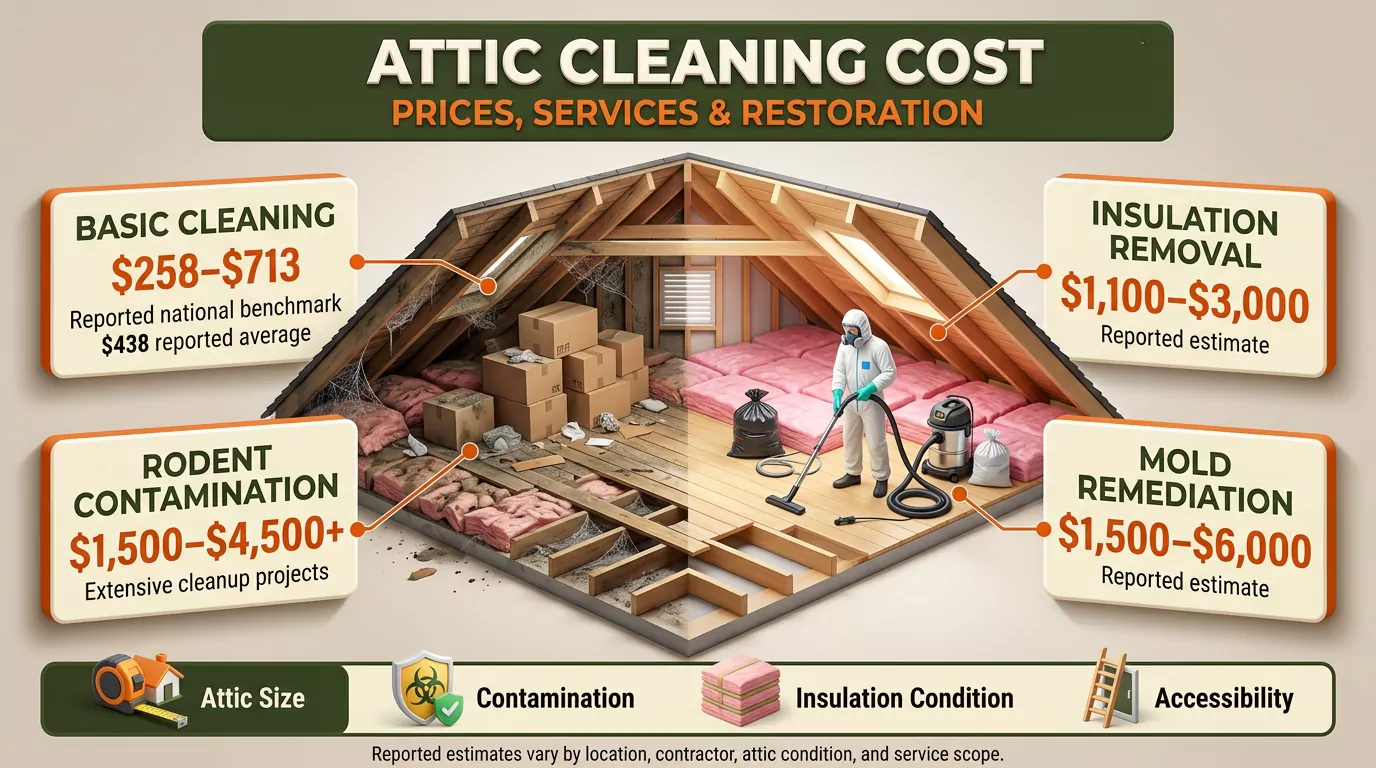
Attic inspection and cleaning costs depend on the condition of your attic and the work required. Basic dust removal may cost a few hundred dollars, while extensive mold remediation and HVAC repairs can exceed $10,000.
The main cost factors include attic accessibility, moisture damage, contaminated insulation, ductwork problems, and structural repairs. A professional attic inspection helps identify these problems before they become more expensive.
This guide explains typical U.S. service costs, common attic problems, repair options, and ways to prevent future damage.
How Much Do Attic Inspection and Cleaning Services Cost?
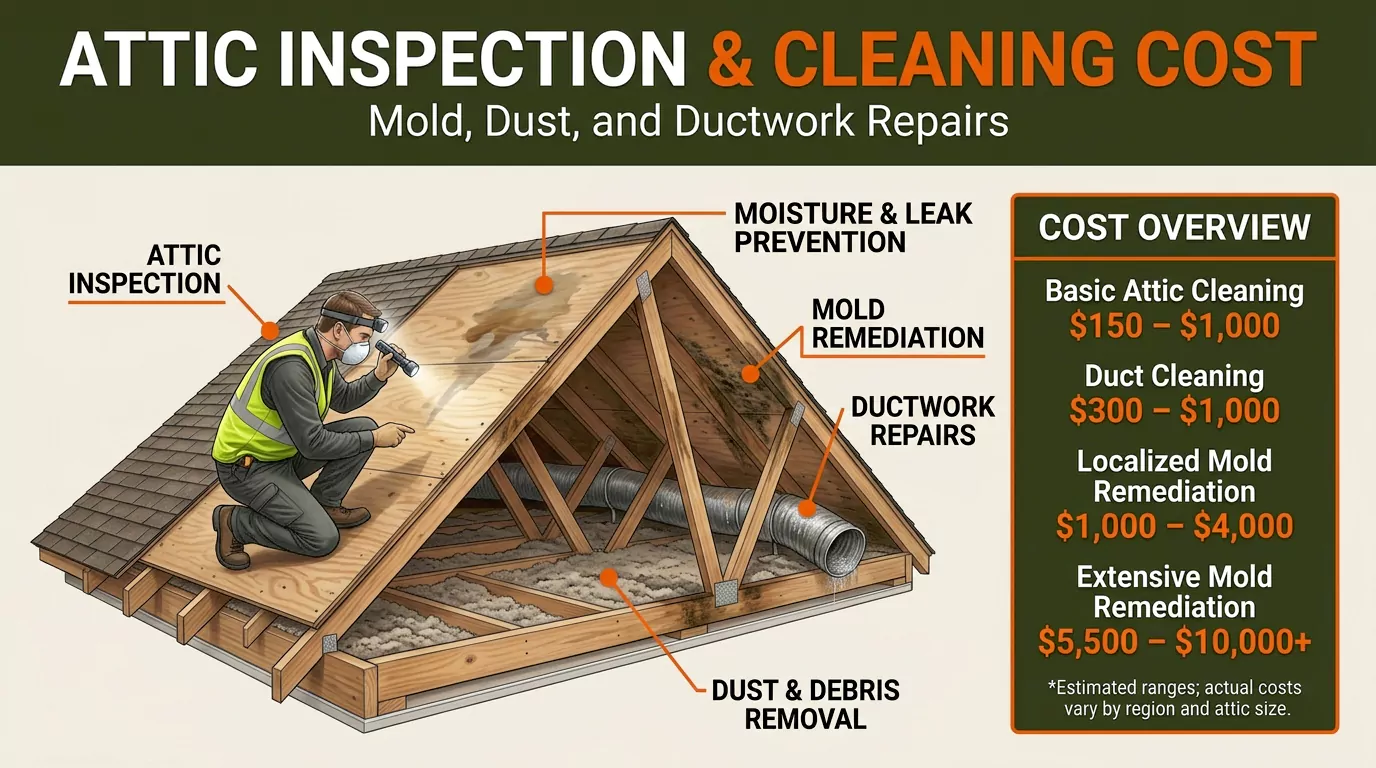
The combined cost of attic inspection, dust removal, ductwork repairs, and mold remediation can range from approximately $1,500 to $10,000 or more. Smaller projects may cost less, while extensive contamination and duct replacement can increase the total.
The following figures come from the supplied pricing research. They are preliminary budgeting estimates, not guaranteed quotes or verified nationwide averages.
| Attic service | Estimated cost |
| General home inspection that includes the attic | 400–600 |
| Specialized mold or pest inspection | 200–650 |
| Basic attic cleaning and dust removal | 150–1,000 |
| Standard HVAC duct cleaning | 300–1,000 |
| Localized attic mold remediation | 1,000–4,000 |
| Extensive attic mold remediation | 5,500–10,000+ |
| Extensive HVAC mold remediation or ductwork work | 2,800–8,000+ |
| Ventilation improvements | 200–800 |
Prices vary by location, labor rates, attic size, contamination, and project scope. These services may overlap, so adding every figure together can overstate the total.
For example, a dusty attic with intact insulation may need only an inspection and targeted cleaning. An attic with mold, wet insulation, and leaking ducts may require several separate services.
What affects the total project cost?
Several factors determine the final estimate:
- Affected area: Larger contaminated surfaces generally require more labor and materials.
- Accessibility: Low-clearance spaces and narrow openings can slow down work.
- Moisture damage: Roof leaks and condensation may require repairs before cleanup is complete.
- Insulation condition: Wet or contaminated insulation may need removal and replacement.
- HVAC condition: Damaged ducts may require cleaning, sealing, insulation, or replacement.
- Containment requirements: Significant mold contamination may require barriers and HEPA air filtration.
- Testing and verification: Some projects need additional assessments or clearance sampling.
The best starting point is an inspection that identifies the problem and defines the required work.
What Does a Professional Attic Inspection Include?
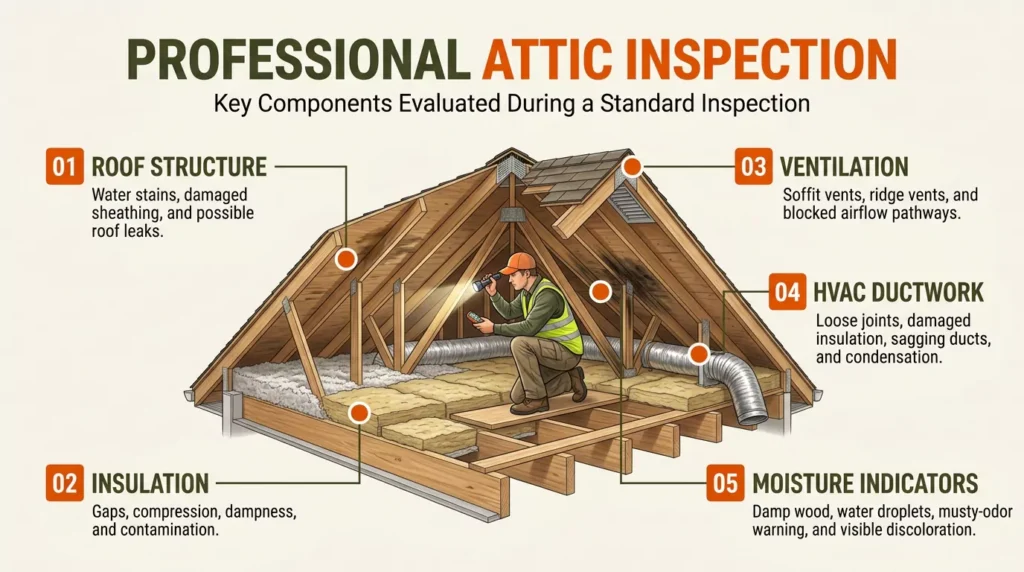
A professional attic inspection evaluates the roof structure, insulation, ventilation, ductwork, and visible moisture problems. It helps identify defects that may affect the home’s comfort, efficiency, or building materials.
A routine home inspection is not necessarily the same as a specialized mold or moisture assessment.
Attic inspection checklist
1. Roof structure and sheathing
The inspector looks for water stains, deteriorated wood, damaged sheathing, and signs of roof leaks. Areas around flashing, chimneys, and roof penetrations deserve particular attention.
2. Insulation condition
The inspector checks for gaps, compression, displacement, dampness, and visible contamination. Wet or damaged insulation may no longer perform as intended.
3. Ventilation
The assessment examines available intake and exhaust ventilation, including soffit and ridge vents where present. Blocked vents or poorly designed airflow may contribute to moisture accumulation.
4. HVAC ductwork
The inspector looks for disconnected joints, damaged insulation, air leakage, sagging flexible ducts, and visible condensation. These defects can affect energy efficiency and moisture control.
5. Moisture and mold indicators
Dark patches, musty odors, damp wood, and water droplets may indicate a moisture problem. However, appearance alone cannot identify a mold species or establish the extent of contamination.
6. Air leakage and exhaust ducts
Gaps around wiring, plumbing, and ceiling penetrations can allow humid indoor air into the attic. Bathroom exhaust ducts should discharge outdoors rather than into the attic.
7. Dust, debris, and pests
The inspector may identify accumulated dust, insulation fragments, animal droppings, nesting materials, and other debris. These findings help determine whether ordinary cleaning or specialized cleanup is appropriate.
General inspection versus mold testing
Different inspections serve different purposes.
| Service | Main purpose |
| General attic inspection | Identify visible defects and maintenance concerns |
| Moisture assessment | Investigate damp materials and possible water sources |
| Mold assessment | Evaluate suspected growth and affected materials |
| Laboratory mold testing | Analyze samples when results can answer a specific question |
| Post-remediation verification | Assess whether agreed cleanup goals have been achieved |
Mold testing is not automatically necessary in every situation. When visible growth and its moisture source are already evident, a professional assessment may be more useful than sampling alone.
Ask what the inspection includes before paying for specialized testing.
What determines attic inspection cost?
Inspection costs depend on the inspector’s qualifications, attic size, accessibility, location, and report requirements. Thermal imaging, moisture mapping, laboratory analysis, and other specialized services may cost extra.
A written report with photographs and moisture readings can help document findings. It also makes competing remediation proposals easier to compare.
What Causes Attic Dust, Condensation, and Mold?
Attic dust, condensation, and mold can occur together, but they do not always share the same cause.
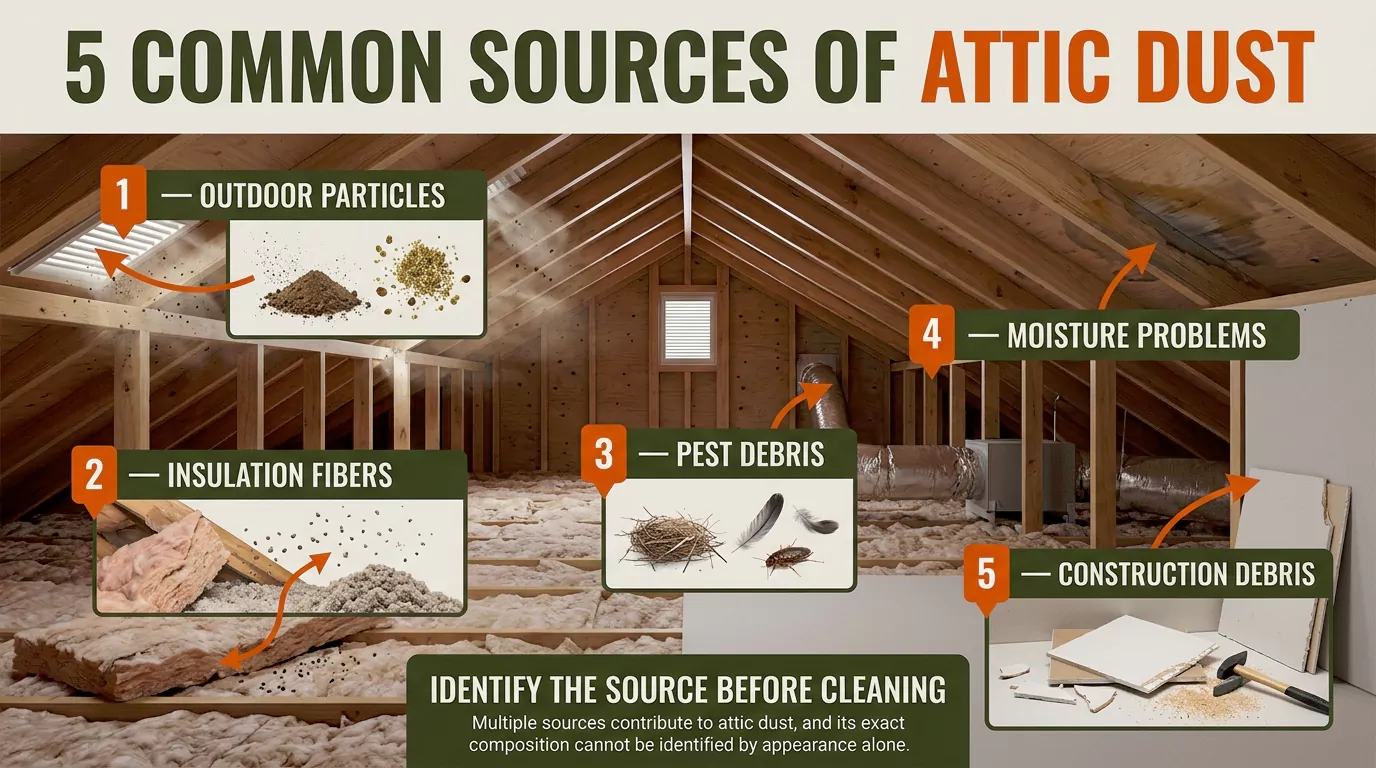
Dust may come from insulation fibers, construction debris, pests, and air leakage. Condensation forms when moist air contacts a surface cold enough for water vapor to condense. Mold can grow when susceptible materials remain damp.
Identifying the moisture source is essential because cleaning alone may not prevent the problem from returning.
Common sources of attic dust
Attic dust can contain several different materials:
- Airborne household particles entering through ceiling gaps.
- Fiberglass or other insulation fragments.
- Construction dust and deteriorating building materials.
- Soil and debris entering through attic openings.
- Animal hair, nesting materials, and pest waste.
- Particles from damaged HVAC components or duct insulation.
Dust on insulation does not automatically mean mold is present. Visible fibers should not be disturbed until their source is understood.
If the attic contains heavy pest contamination, deteriorated insulation, or suspicious building materials, consider professional cleanup instead of ordinary household cleaning.
Why does condensation form in an attic?
Attic condensation develops when moisture in the air contacts a sufficiently cold surface.
For example, warm indoor air may escape through ceiling gaps during cold weather. When that air reaches cold roof sheathing, moisture can condense on the wood.
The same principle applies to cold HVAC ducts during humid conditions.
Common contributing factors include:
- Air leakage from living spaces.
- High indoor humidity.
- Inadequate duct insulation.
- Damaged vapor-control layers where required.
- Poorly balanced attic ventilation.
- Bathroom exhaust fans discharging into the attic.
- Roof or plumbing leaks that resemble condensation damage.
Condensation may appear as water droplets, damp insulation, darkened wood, or recurring moisture around ducts.
How attic condensation contributes to mold
Persistent moisture allows mold to grow on susceptible materials, including wood and some insulation surfaces. Dust may collect on these surfaces, but dust alone does not cause mold.
Mold growth depends on moisture, suitable materials, temperature, and time. Correcting the moisture source is therefore central to long-term prevention.
A dark stain should not automatically be labeled toxic black mold. Different materials can develop similar discoloration, and appearance alone cannot reliably identify a species.
How Much Does Attic Cleaning Cost?
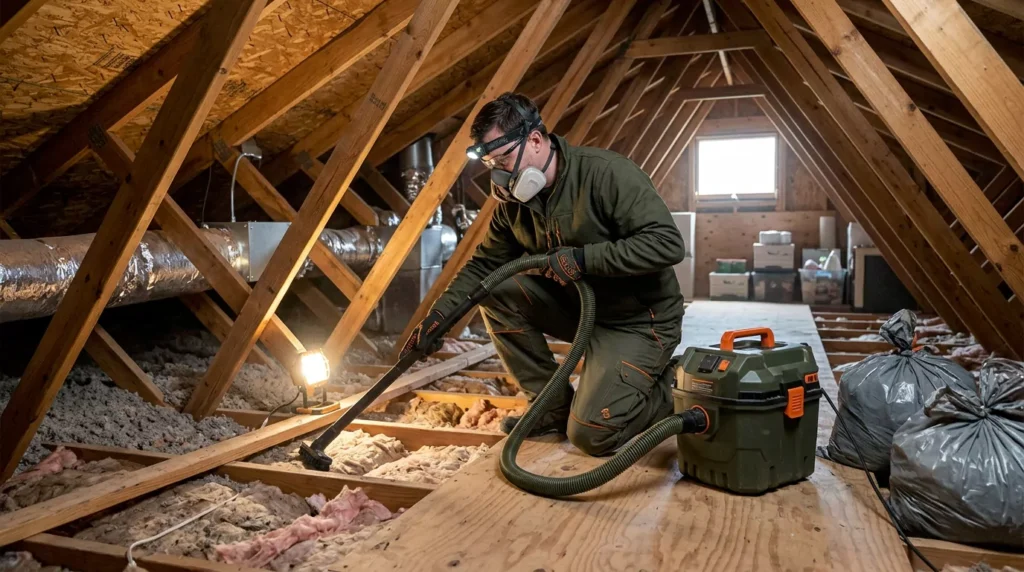
Basic Attic Cleaning Cost an estimated 150–1,000, depending on debris volume, accessibility, and service scope. Extensive cleanup involving contaminated insulation, animal waste, or mold requires a different approach and can cost substantially more.
Basic dust removal and debris cleanup
Routine attic cleaning may include:
- Removing loose debris and unwanted materials.
- Vacuuming accessible surfaces with suitable HEPA-filtered equipment.
- Collecting dust and insulation fragments.
- Bagging and disposing of specified waste.
- Documenting visible damage or contamination.
Not every attic needs a complete cleaning. If dust is limited and insulation remains in good condition, targeted cleaning may be sufficient.
The contractor should explain which surfaces will be cleaned and which areas will remain untouched.
What increases attic cleaning costs?
Cleaning becomes more complex when workers encounter heavy debris, narrow access points, pest waste, damaged insulation, or suspected mold contamination.
The estimate should identify these services separately:
- Basic debris removal.
- HEPA vacuuming and surface cleaning.
- Animal waste cleanup and disposal.
- Removal of damaged or contaminated insulation.
- Mold remediation and containment.
- Replacement insulation and related repairs.
These services are not interchangeable. Ordinary dust removal does not replace appropriate mold remediation when significant contamination is present.
Does attic insulation need to be replaced?
Not always. The decision depends on the insulation material, its condition, contamination, and whether it can be adequately cleaned or dried.
Wet, heavily contaminated, or deteriorated insulation may require removal. Clean, dry insulation may remain usable if its condition and performance are acceptable.
Before approving replacement, ask the contractor to document the affected areas and explain why removal is necessary.
How Much Does Attic Mold Remediation Cost?
Attic mold remediation may cost approximately 1,000–4,000 for some localized or average projects. Extensive contamination can reach 5,500–10,000 or more, especially when insulation removal, structural repairs, or HVAC work is involved.
The final price depends on contaminated surface area, affected materials, access, containment requirements, and the underlying moisture source.
Mold remediation cost by project scope
The following ranges summarize the supplied pricing research. They are illustrative estimates rather than fixed industry rates.
| Project type | Typical conditions | Indicative cost |
| Small or localized cleanup | Limited growth and accessible surfaces | 1,000–2,500 |
| Moderate remediation | Growth across several areas and possible insulation removal | 2,500–4,500 |
| Extensive attic remediation | Widespread contamination and more demanding containment | 4,500–7,500+ |
| Remediation with structural repairs | Damaged decking or other materials requiring replacement | 5,000–10,000+ |
These ranges overlap because square footage alone does not determine the price. A small area with difficult access or significant material damage may cost more than a larger, straightforward project.
Local labor rates also matter. One supplied Austin-area source places many attic remediation projects between $1,500 and $7,500. That regional estimate should not be treated as a nationwide average.
What is included in mold remediation?
A professional remediation project may involve several stages.
Assessment: The contractor identifies affected materials, checks moisture conditions, and defines the work area.
Containment: Barriers and other controls help limit the spread of contaminated particles into occupied areas.
Air filtration: HEPA-filtered equipment may be used when appropriate for the contamination and working conditions.
Removal or cleaning: Workers remove materials that cannot be adequately cleaned and clean suitable surfaces using appropriate methods.
Drying and moisture correction: The moisture source is repaired, and affected materials are dried as needed.
Restoration: Damaged insulation, sheathing, or other building components may need repair or replacement.
Verification: The contractor or an independent professional assesses whether the agreed remediation goals have been achieved.
The exact scope depends on the project. A written estimate should identify which stages are included and which require additional payment.
Additional costs to consider
Mold remediation does not automatically include every repair needed to restore an attic.
Potential additional charges include:
- Roof leak repairs or flashing replacement.
- Removal and replacement of damaged insulation.
- Replacement of rotted roof sheathing or framing.
- HVAC duct cleaning, sealing, or replacement.
- Bathroom exhaust duct correction.
- Additional moisture assessments or laboratory testing.
- Drywall repairs when access requires opening a ceiling.
- Post-remediation verification and documentation.
Ask the contractor to separate remediation from reconstruction. This distinction makes the total budget easier to understand.
How to Fix Ductwork Condensation in an Attic
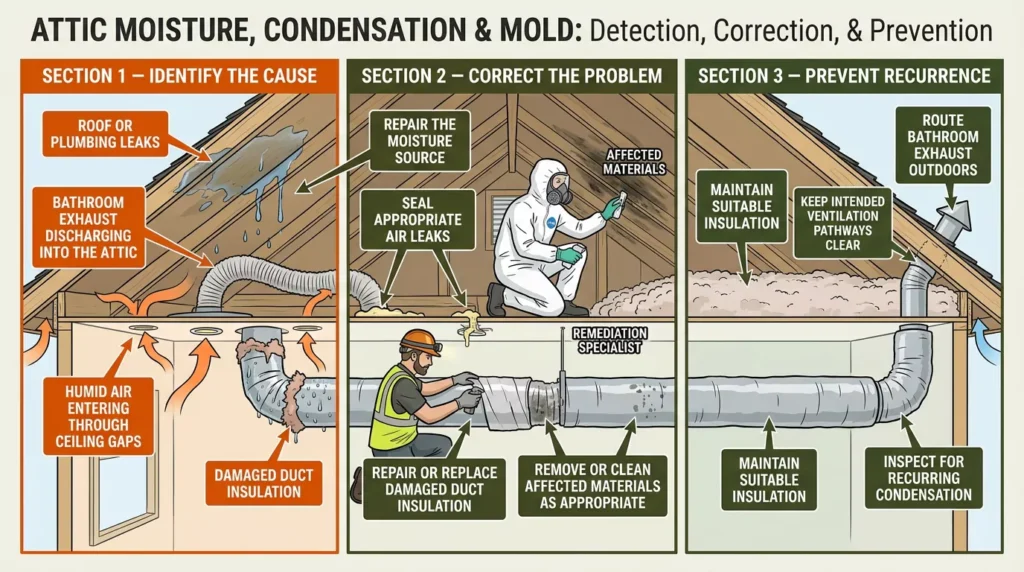
Ductwork condensation occurs when moisture in the surrounding air condenses on a cold duct surface. It becomes more likely when duct insulation is inadequate or damaged and humid air reaches the cold surface.
The correct solution depends on where condensation forms and why.
1. Inspect duct insulation
Check for missing, torn, compressed, or damaged insulation. Inadequate insulation allows the duct surface to become colder relative to the surrounding air.
A qualified HVAC professional can determine whether the insulation is suitable for the duct type and climate.
2. Check duct joints and air leakage
Loose connections and damaged ducts can leak conditioned air. These leaks may reduce system efficiency and contribute to temperature or moisture problems.
Duct sealing should use materials and methods suitable for the system. Replacing duct insulation will not repair a disconnected joint.
3. Investigate humidity and air leakage
High indoor humidity and humid air entering the attic can increase condensation risk. Check bathroom exhaust routing, ceiling penetrations, and other possible moisture sources.
Reducing unnecessary air leakage and managing indoor humidity can help address the underlying problem.
4. Determine whether cleaning is necessary
Duct cleaning may be appropriate when an assessment identifies significant dust or contamination inside the system. However, cleaning alone does not correct damaged insulation, leaking joints, or excessive humidity.
If mold is suspected inside ductwork, ask the contractor to identify affected components and explain the proposed treatment.
5. Repair or replace damaged ducts
Flexible ducts that are torn, crushed, or severely deteriorated may require replacement. Other ducts may be repairable.
Replacement should follow an inspection rather than being assumed from condensation alone.
How much does ductwork repair cost?
The supplied pricing research gives these broad estimates:
| HVAC service | Indicative cost |
| Standard duct cleaning | 300–1,000 |
| Duct sealing or insulation repairs | Requires a system-specific estimate |
| Extensive HVAC mold remediation or ductwork work | 2,800–8,000+ |
| Full duct replacement | Requires a system-specific estimate |
The higher range is not a standard price for every mold-related duct problem. Costs depend on system size, affected components, access, and whether cleaning, repairs, or replacement are necessary.
The Professional Mold Remediation Process
A reliable remediation process addresses both visible contamination and the conditions that allowed it to develop.
Step 1: Assess the attic
The professional identifies affected surfaces, checks moisture conditions, and documents visible damage. The assessment should consider roof leaks, duct condensation, plumbing leaks, and humid-air entry.
Step 2: Correct the moisture source
Repairs may involve fixing the roof, rerouting an exhaust duct, sealing air leaks, or correcting HVAC insulation problems.
Some repairs can happen alongside remediation, but the plan must prevent continued moisture exposure.
Step 3: Establish appropriate containment
The contractor determines whether barriers, protective equipment, and HEPA air filtration are needed. Requirements depend on the size and nature of the work.
Step 4: Remove or clean affected materials
Suitable surfaces are cleaned using methods appropriate for their condition. Materials that cannot be adequately cleaned may need removal and replacement.
Routine surface treatment is not a substitute for removing unsalvageable materials.
Step 5: Dry the affected area
Moisture readings and material conditions help determine whether drying is complete. The source of moisture must remain corrected.
Step 6: Verify the results
The contractor reviews the completed work, checks for remaining visible contamination, and assesses whether the moisture problem has been addressed.
Independent assessment or sampling may be appropriate when required by the project scope, contractual agreements, or other specific circumstances.
How to Compare Quotes and Reduce Attic Repair Costs
The cheapest estimate is not always the best value. A lower price may exclude insulation replacement, containment, duct repairs, or other work needed to resolve the problem.
Request itemized estimates
Ask each contractor to identify:
- Inspection and assessment charges.
- The estimated affected area.
- Cleaning and remediation methods.
- Containment and filtration requirements.
- Insulation removal and replacement.
- HVAC cleaning or repairs.
- Roof and structural repairs.
- Testing or verification, if included.
- Disposal, warranty terms, and exclusions.
This information makes competing quotes easier to compare.
Questions to ask before hiring a contractor
- What caused the moisture or mold problem?
- Which areas and materials are included in the estimate?
- Does the price include containment and waste disposal?
- Will damaged insulation or ducts require separate work?
- What happens if hidden damage appears?
- What training, insurance, and relevant credentials can you document?
- Will you provide photographs and a written completion report?
If mold testing is proposed, ask what question the test is intended to answer and how its results will affect the work.
Can homeowners insurance cover mold remediation?
Coverage depends on the policy and the cause of the damage. Some policies may cover mold remediation associated with a covered, sudden water event. Long-term leaks, condensation, and maintenance-related problems may be excluded.
Review your policy and contact your insurer before authorizing major work. Keep photographs, inspection reports, repair records, and estimates to support a claim if necessary.
Avoid paying twice for the same problem
The most useful cost-saving measure is correcting the underlying moisture source.
Cleaning mold without fixing a roof leak leaves the attic vulnerable to further growth. Likewise, cleaning HVAC ducts will not resolve condensation caused by inadequate insulation.
Bundling related services may reduce repeated setup or inspection charges. Confirm that each service is necessary and separately priced.
How to Prevent Attic Dust, Condensation, and Mold
Preventive maintenance helps identify problems before they spread into insulation, roof sheathing, or HVAC components.
Improve attic air sealing
Seal appropriate gaps around plumbing penetrations, wiring, and other ceiling openings. Air sealing can reduce the movement of humid indoor air into the attic.
Use suitable methods around heat-producing equipment and electrical components. Do not block ventilation openings or compromise required safety clearances.
Maintain appropriate insulation
Insulation helps control heat transfer and keeps building surfaces closer to intended temperature conditions. Damaged or poorly installed insulation can contribute to energy loss and moisture problems.
Check for compression, gaps, displacement, and wet areas. Correct the moisture source before installing replacement insulation.
Keep ventilation balanced
Attic ventilation should suit the building design and climate. Where a vented attic is intended, clear intake and exhaust pathways can support moisture management.
Do not assume that adding an exhaust fan or extra vents will solve every problem. Ventilation improvements should work with air sealing and insulation rather than pulling excessive conditioned air from the home.
Correct ductwork problems
Inspect accessible ductwork for damaged insulation, loose connections, and condensation. Repair defects and investigate humidity sources before they cause repeated damage.
Bathroom exhaust fans should discharge outdoors through suitable ductwork.
Follow a practical inspection schedule
Inspect the attic periodically and after significant roof leaks, storms, HVAC changes, or other moisture events.
Look for:
- New water stains or darkened wood.
- Damp or compressed insulation.
- Musty odors.
- Water droplets on ducts or roof sheathing.
- Damaged exhaust ducts.
- Blocked ventilation openings.
- New pest debris or unusual dust accumulation.
A recurring moisture problem deserves further investigation rather than repeated surface cleaning.
Frequently Asked Questions
How much does an attic inspection and cleaning cost?
A general home inspection that includes the attic may cost approximately 400–600 in the supplied estimates. Specialized inspections may fall around 200–650, while basic attic cleaning may cost 150–1,000. These services have different scopes and may be priced separately.
How much does attic mold remediation cost?
The supplied research indicates that some localized or average projects cost around 1,000–4,000. More extensive remediation can reach 5,500–10,000 or more. Structural damage, insulation replacement, access limitations, and HVAC work can increase the total.
Is attic mold dangerous if it stays in the attic?
Mold exposure can cause allergic reactions or respiratory symptoms in some people, particularly those sensitive to mold. An attic’s location does not guarantee that its particles remain isolated from occupied areas. Avoid disturbing suspected growth and arrange an appropriate assessment.
Do I need mold testing before remediation?
Not necessarily. Testing may help answer specific questions, but visible mold and an identifiable moisture source can sometimes be assessed without laboratory sampling. Discuss the purpose, limitations, and expected value of testing before ordering it.
Can I clean attic mold myself?
Limited, minor surface contamination may be manageable in some circumstances. Extensive growth, contaminated insulation, hidden moisture, or structural damage calls for professional assessment. Avoid dry brushing or other methods that can spread particles, and follow appropriate safety guidance.
Does duct cleaning stop condensation?
No. Duct cleaning removes specified deposits or contamination from accessible HVAC components. Condensation requires a separate investigation into duct temperature, insulation, humidity, air leakage, and other moisture sources.
Should moldy attic insulation always be replaced?
No. Replacement depends on the material’s condition, contamination, moisture exposure, and whether proper cleaning or drying is feasible. Wet, damaged, or unsalvageable insulation may need removal.
How long does attic mold remediation take?
The duration depends on the affected area, access, containment requirements, drying, and repair work. A small, accessible project may take less time than widespread remediation involving insulation and structural repairs. Ask for a project-specific schedule.
Will a solar attic fan prevent mold?
Not by itself. An attic fan cannot repair roof leaks, seal ceiling gaps, or correct damaged duct insulation. The correct moisture-control strategy depends on the attic design, existing ventilation, and source of humidity.
What should an attic remediation quote include?
A useful quote identifies affected areas, cleaning or removal methods, containment, protective equipment, disposal, insulation work, moisture-source repairs, and any testing or verification. It should also explain exclusions and how unexpected damage will be handled.
Final Thoughts
Attic inspection, dust removal, ductwork repairs, and mold remediation address different problems that can overlap. Their costs depend on affected materials, accessibility, moisture sources, and the required scope of work.
Start with a clear assessment rather than assuming every attic needs the same treatment. Compare itemized estimates, correct the source of moisture, and confirm which repairs are necessary.
The best long-term solution is not simply a cleaner attic. It is an attic with sound materials, appropriate insulation, properly functioning ductwork, and effective moisture control.

Daniel Carter specializes in attic maintenance, insulation, ventilation, moisture control, and home improvement. He understands common attic problems and their practical solutions. Through clear, informative guides, he helps homeowners identify issues, prevent damage, improve energy efficiency, and maintain safer, healthier homes.